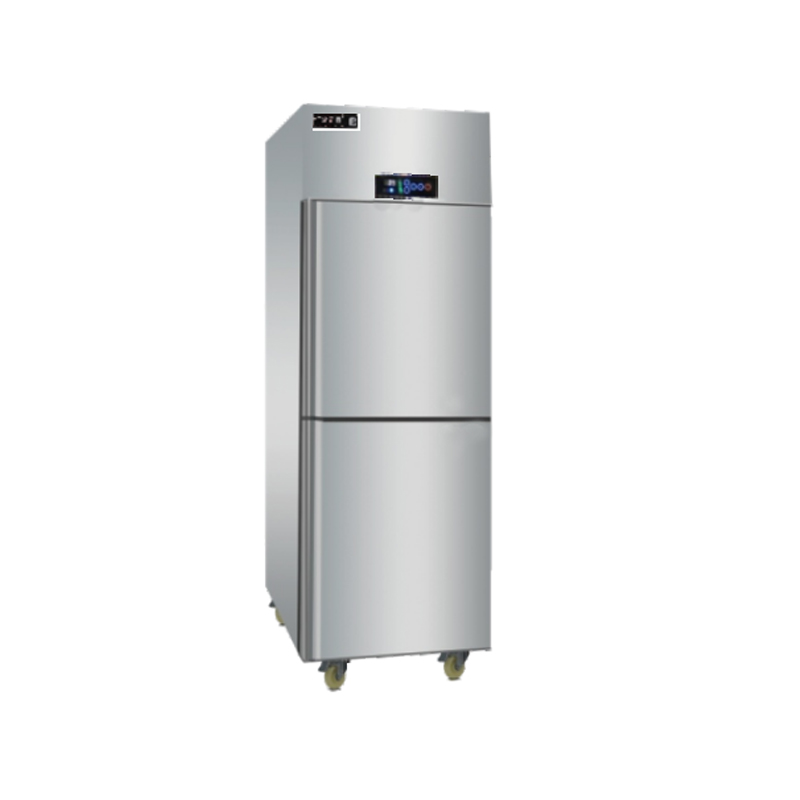
Jiangsu Bingluo Refrigeration Equipment Co., Ltd. has manufactured commercial refrigeration equipment since 2006, working from a production base in the Dianshan Lake Development Zone of Kunshan, Jiangsu. Our Commercial Upright Refrigerator range is the vertical storage backbone of that offer: tall, front-loading cabinets built for kitchens, bars, bakeries, dessert counters, milk tea shops, hotels, hospitals and retail back rooms that need dense chilled or frozen capacity in a small footprint.
We supply the category as two stainless steel series, direct-cool and air-cooled, each available in 201 or 304 grade steel and in refrigerated or frozen operating modes. Cabinets are configured around the storage task, the door type, the ambient conditions of the room and the way staff will load and reach for product during a shift.
The Bingluo Upright Range at a Glance
Two product families carry the category. The Commercial 201/304 Stainless Steel Direct-cool Upright Refrigerator uses a static evaporator arrangement, which suits sites where low running noise and simple internal layout matter more than rapid recovery after long door openings. The Commercial 201/304 Stainless Steel Upright Air-cooled Refrigerator circulates cold air through the cabinet and adds automatic defrost-water evaporation, so no manual drainage is required.
| Series |
Cooling Method |
Typical Fit |
Notable Configuration |
| Direct-cool upright |
Static evaporator |
Back-of-house storage, low-noise zones, steady-load kitchens |
Solid door, adjustable reinforced shelves, chill or freeze mode |
| Air-cooled upright |
Forced-air circulation |
High-traffic service lines, glass-door merchandising, mixed loads |
Automatic defrost-water evaporation, glass door with blue-light disinfection |
| Steel grade |
201 or 304 stainless steel |
Wet, greasy or hygiene-sensitive areas |
304 specified for stronger corrosion resistance |
| Operating mode |
Refrigeration or freezing |
Chilled prep lines or frozen stock holding |
Selected at order stage, not switched in service |
Construction and Daily Handling
Every cabinet is built from stainless steel inside and out, which keeps surfaces wipeable and resists the fats, sugars and cleaning agents found in food service. A thick insulation layer holds cold between openings, and the self-closing door design pulls the leaf shut on its own to limit cold-air loss during busy service.
- Reinforced adjustable shelves carry heavier loads and can be repositioned as stock profiles change between seasons or menus.
- LED digital temperature control gives staff a readable set point and current value without opening the door.
- High-efficiency compressor selected for stable pull-down with low operating noise.
- Glass-door variants on the air-cooled series include a blue-light disinfection system for stored items.
Matching the Cabinet to the Application
Upright cabinets earn their place where floor area is tight and vertical storage is the only way to hold enough stock. The same platform serves very different duty cycles, and the choice between direct-cool and air-cooled usually follows the pattern of door openings rather than the product being stored.
Kitchens and bakeries
Solid-door units hold prep ingredients, dough, cream and finished goods. Direct-cool suits steady back-of-house loads; air-cooled suits stations opened repeatedly through service.
Bars, cafés and milk tea counters
Glass-door air-cooled cabinets keep bottles, syrups, fruit and dairy visible to staff. Pair them with our Bar Equipment and ice systems for a coordinated front counter.
Hotels, hospitals and retail
Freeze-mode cabinets hold bulk frozen stock; chill-mode units support ward pantries, breakfast buffets and supermarket back rooms where hygiene and easy cleaning are priorities.
Specifications That Shape the Proposal
Capacity figures only mean something once the internal layout is fixed. We size the cabinet around the trays, gastronorm pans, crates or bottles that will actually go inside, then confirm the shelf pitch and the clear height between levels. External width and depth are checked against the doorway, corridor and final position, because a tall cabinet that cannot be wheeled into the room is a problem no specification sheet solves.
- Temperature band — chilled or frozen duty, and the ambient room temperature the unit will work in.
- Door type — solid or glass, and whether the door is left- or right-hinged for the access route.
- Internal fit-out — number of shelves, shelf load, pan or tray sizes, and any need for dividers.
- Utilities — single-phase power, a dedicated circuit, and ventilation clearance at the rear and top.
- Floor and movement — castors or levelling feet, and whether the unit stays fixed or is repositioned for cleaning.
Building a Coordinated Refrigeration Package
Most projects need more than one cabinet type. A milk tea shop may combine upright storage with under-counter ice and a water bar; a bakery pairs upright chillers with a dedicated bakery refrigerator and a display cabinet for finished cakes. Because we manufacture across these families, the stainless finish, control style and door hardware can be kept consistent across a fit-out.
Related equipment we produce for the same sites includes the Commercial Horizontal Refrigerator for under-counter prep, Refrigerated Display Cases for front-of-house presentation, and ice makers where drinks are served. Grouping these on one order keeps delivery, documentation and spare-part planning on a single schedule.
Manufacturing and Quality Control
Production runs in a 12,500 m² standardized factory on a site of more than 30 acres, using an Industry 3.0 production and management system and a dedicated commercial refrigerator line. Incoming stainless steel is checked before fabrication, and cabinets are assembled and tested before packing. Our own laboratory and test equipment support the inspection routine, and each unit is run and checked for cooling performance and control function before it leaves the line.
Customization is handled as a defined process: requirement analysis, solution design covering dimensions, layout and material grade, manufacturing, then installation guidance and after-sales support. We can develop and produce units against customer samples where a project calls for a non-standard size or internal arrangement.
Delivery, Installation and Service
Cabinets ship with protective packaging suited to container and less-than-container loads, and the delivery scope is confirmed at order stage so that site teams know what arrives and what they must prepare. Online installation guidance covers positioning, ventilation clearance, power connection and initial pull-down. After-sales support includes remote or on-site technical assistance, regular inspection and preventive maintenance, and original spare parts to shorten downtime.
Information We Use to Configure Your Solution
A workable quotation starts from the operating conditions, not from a model number. The details below let us propose the right series, steel grade, door type and internal fit-out in one pass.
| Project Input |
Why It Matters |
| Product to be stored and its target temperature |
Sets chill or freeze mode and the cooling method |
| Container sizes and daily stock volume |
Determines internal height, shelf count and cabinet width |
| Door openings per shift and room ambient |
Points to direct-cool or air-cooled, and to insulation needs |
| Site access, doorway width and final position |
Confirms dimensions, hinge side and castor or feet choice |
| Power supply and ventilation clearance |
Matches the compressor and electrical configuration |
| Quantity, delivery schedule and destination |
Shapes packing, batch planning and shipping documents |
Frequently Asked Questions
What is the difference between the direct-cool and air-cooled upright refrigerators?
The direct-cool model uses a static evaporator and suits steady storage loads where low noise matters. The air-cooled model circulates cold air for faster recovery after door openings and adds automatic defrost-water evaporation, so there is no manual drainage. Glass-door air-cooled units also include a blue-light disinfection system.
Should I choose 201 or 304 stainless steel?
Both grades are available across the range. 304 offers stronger corrosion resistance and is the usual choice for wet, greasy or hygiene-sensitive areas; 201 is a practical option where the environment is drier and the budget is tighter. We confirm the grade at order stage so it matches the site conditions.
Can one cabinet be used for both chilled and frozen storage?
The range supports refrigeration and freezing modes, but the mode is fixed when the unit is configured. A cabinet intended for frozen stock is built and set for that duty. For sites needing both, we usually propose separate chill and freeze units rather than a single compromise cabinet.
Can you supply non-standard sizes or internal layouts?
Yes. Customization covers dimensions, internal layout and material selection, and we can develop and produce units from customer samples. Sharing the container sizes, available floor space and access route at the enquiry stage lets us design a cabinet that fits both the stock and the room.
What support comes with an order?
We provide online installation guidance, commissioning checks, remote or on-site technical support, preventive maintenance visits and original spare parts. Warranty options of three years, five years or longer terms are available, and we can advise on energy-saving operation based on your usage data.

 English
 русский
 Español
 عربى
 Commercial Horizontal Refrigerator