 English
 русский
 Español
 عربى
Industry News
Home / News / Industry News / Bulk Frozen Food Storage Freezers: A Practical Guide for Commercial Kitchens
2026-11-04
Ask most people what makes bulk frozen food storage work and they will talk about containers. Search the phrase and you will find plenty of guidance on glass tubs, vacuum bags and stackable boxes. That advice is useful, but it is only half the picture. For a café, bakery, hotel kitchen or small supermarket, the container is the last link in a chain that starts with the freezer holding it at a stable temperature.
We have been building commercial refrigeration equipment since 2006, and the questions we hear from buyers are rarely about packaging. They are about how much space to allow, how cold the unit should really run, and why a freezer that looked generous on paper is full within a month.
Content
A domestic freezer is built for occasional use. A bulk storage freezer works much harder: larger volumes go in, the door opens far more often, and the kitchen around it is warmer. A cabinet holding 300 kg of frozen product still has to pull heat out quickly after a delivery, or the surface of the food softens, refreezes and loses quality.
Four things separate a unit that copes from one that struggles:
Get those right and frozen stock stays dense, firm and free of freezer burn. Get them wrong and you spend the year trimming pale edges off product that was perfectly good when it went in.
There is no single best shape. Most well-planned kitchens combine two of the options below, and the guidance here reflects the units we build across our commercial refrigerator range as well as what we see on customer sites.
Uprights give you a narrow footprint and clear shelving, so staff can see what is in stock without unloading half the cabinet. The trade-off is that cold air spills out every time the door opens, which makes them best suited to high-turnover lines that go in and out several times a day. Look for sturdy shelf clips and a stainless steel interior that will survive trolley knocks.
In a horizontal cabinet the cold air stays where it is when the lid lifts, so recovery is fast and energy use is lower. These units suit long-hold stock and low-traffic bulk items, though reaching the bottom of a deep well gets awkward for smaller staff. Undercounter versions slot neatly beneath a prep line where space above the worktop is precious.
Once weekly volume passes a few cubic metres, a walk-in room usually makes more sense than a row of cabinets. Plan racking before insulation: strip curtains, door heaters, an internal release, drainage and a temperature alarm all matter more than the panel thickness people tend to argue about.
Freezing 40 kg of stew in a storage freezer is a slow business. The product drifts through the zone where large ice crystals form, and texture suffers. A blast freezer pulls it through in roughly 90 minutes, after which the batch moves into ordinary storage. If you cook in bulk and freeze in bulk, this pairing does more for quality than any container ever will.
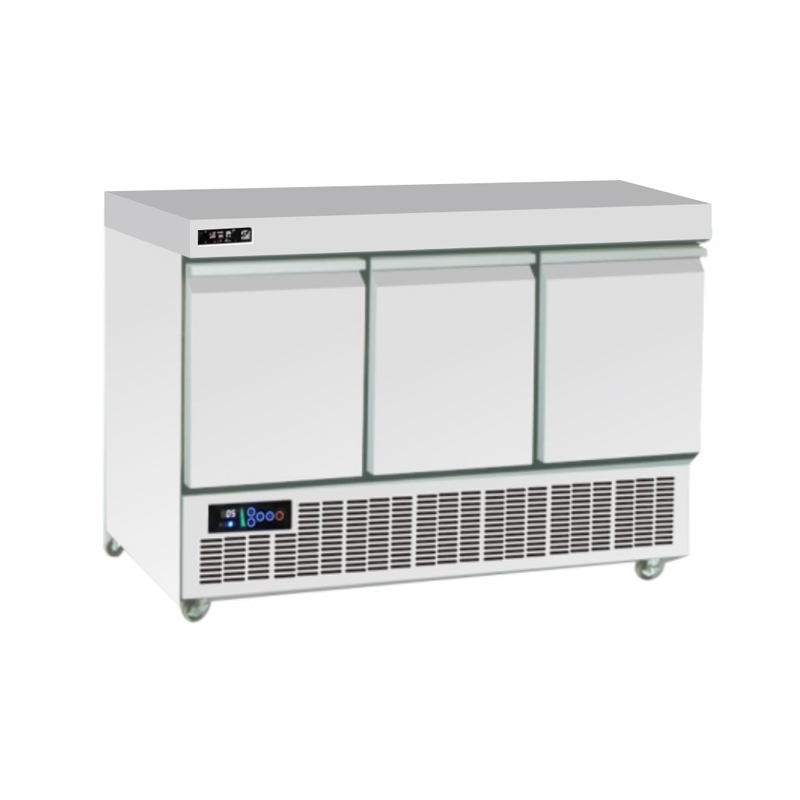 Commercial Blast Chiller/FreezerThe Commercial Blast Chiller/Freezer can rapidly freeze products from room temperature to a center temperature of -18℃ in approximately 180 minutes, preserving the fre...View Product →
| Type | Best for | Footprint | Watch out for |
|---|---|---|---|
| Upright freezer | Fast-moving stock, easy visibility | Small | Cold air loss on every door opening |
| Horizontal freezer | Long-hold bulk, lower running cost | Medium | Awkward access to the base |
| Walk-in room | High volume, pallets or racking | Large | Needs planning, alarms and curtains |
| Blast freezer | Chilling and freezing fresh batches | Medium | Not a substitute for storage capacity |
Nameplate litres flatter a freezer. Once you allow for shelves, baskets and the gaps that let cold air circulate, usable capacity is usually 55–65% of the quoted gross figure. A 1,000-litre cabinet does not hold 1,000 litres of food.
As a working rule, allow roughly 25–30 lb (11–14 kg) of mixed frozen product per cubic foot of usable space, or about 400–500 kg per cubic metre. Then add 10–15% headroom for delivery days, seasonal peaks and the inevitable week when nobody rotated stock properly.
Before you compare models, answer these honestly:
A mid-sized air-cooled upright often covers the storage needs of a busy café or bakery without the running cost of a room, and it is the kind of unit we are asked for most often when a kitchen is upgrading from domestic equipment.
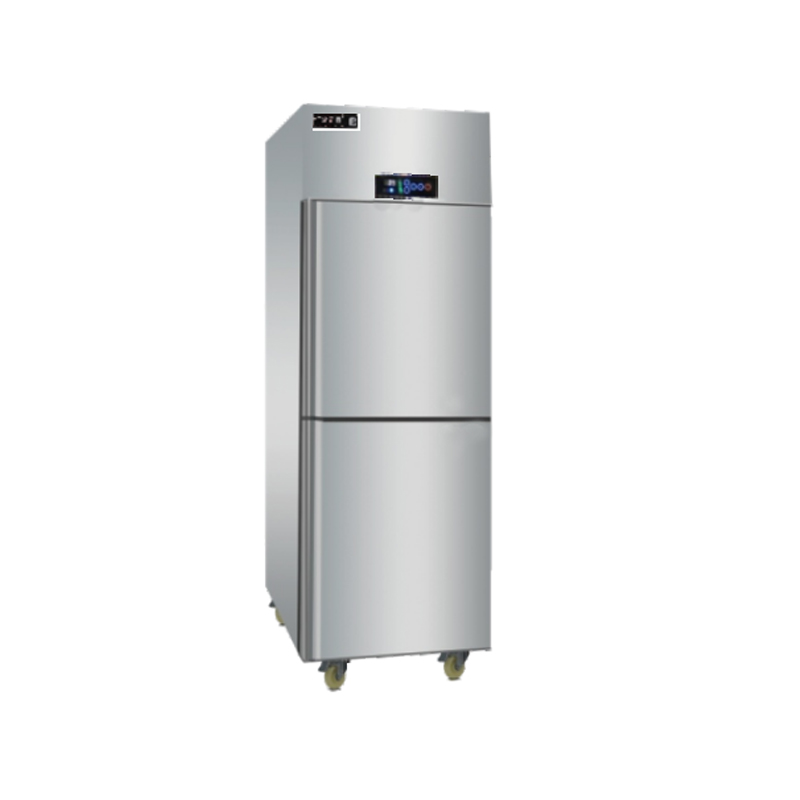 Commercial 201/304 Stainless Steel Upright Air-cooled RefrigeratorIdeal for commercial kitchens, restaurants, supermarkets, hotels, and more, this refrigerator combines precise control, energy efficiency, and hygienic design to meet ...View Product →
Frozen storage is normally held at -18°C (0°F) or colder. Occasional short rises during defrost or a delivery are tolerable; long spells above -15°C are not, because they shorten shelf life quietly and without any obvious warning sign. If you are unsure where your cabinet should sit, this explanation of what temperature a commercial freezer should hold is a sensible starting point.
Airflow matters as much as the setpoint. Leave at least 10 cm between stacked product and the evaporator, keep shelves clear of foil and cardboard that block the fan, and never fill a cabinet to the point where the door will not close on its own.
This is where the packaging advice you find online does apply, with a commercial twist. What matters in a working kitchen is that containers stack squarely, survive repeated washing and let staff identify contents at a glance.
Every container needs a label on the lid and one on the side: product, date frozen, weight or portion count, and who packed it. A label that only says "beef" tells the next shift nothing.
Give each shelf a job. Raw proteins on the bottom, bakery and dough on a dedicated shelf, prepared components together, and a clearly marked area for stock that must be used first. A simple shelf map taped inside the door saves more time than any inventory app in a kitchen of ten people or fewer.
Rotation is a habit rather than a policy. New stock goes behind old stock, labels face outward, and someone checks dates at the start of every shift. When a freezer is packed to the ceiling, this is the first routine that collapses — which is usually the moment to think about capacity.
Most freezer failures we hear about were visible weeks in advance. A gasket that no longer seals, a condenser matted with flour dust, or ice building up on a coil are all small problems until the cabinet stops holding temperature overnight.
Temperature alarms are cheap insurance, particularly for a walk-in room or a cabinet holding a month of stock. If the budget allows only one upgrade this year, make it the alarm rather than a bigger cabinet.
Freezers rarely fail dramatically; they simply stop keeping up. These are the signals we hear most often from operators who eventually replaced or added a unit:
Sometimes the answer is a second cabinet rather than a larger one. Splitting high-turnover stock from long-hold stock reduces door openings and keeps both categories in better condition.
Planning bulk frozen storage is mostly a matter of matching three numbers: how much you freeze, how often it moves, and how quickly the cabinet recovers. Get those aligned and the packaging question becomes easy. If you are working through a layout or sizing a replacement, we are glad to talk through volumes, door widths and delivery routes — practical questions first, hardware second.

No.8 Xinhua Road, Dianshanhu Town, Kunshan City, Suzhou, Jiangsu Province, China
Call Us: +86-18217685733 / +86-18221531811
E-mail: [email protected] / [email protected]
Copyright © Jiangsu Bingluo Refrigeration Equipment Co., Ltd. All Rights Reserved. Commercial Refrigeration Equipment Solutions