 English
 русский
 Español
 عربى
Industry News
Home / News / Industry News / Banquet Buffet Multi-Deck Display: Selection, Placement, and Daily Care
2026-10-26
Walk into a busy banquet hall just before service and you can usually tell whether the buffet was planned around the food or around the guests. A banquet buffet multi-deck display sits right at that meeting point: it has to keep cold food at a safe temperature, show it attractively, and let a line of guests serve themselves without turning into a traffic jam. At Bingluo, we have been building commercial refrigeration equipment since 2006, and much of what we have learned comes from watching operators solve these small practical problems night after night. This guide is a plain-spoken look at what matters when you choose, place, and run one.
Content
A multi-deck display is a refrigerated case with several shelves or tiers, designed to put food at eye level and within reach. In a banquet setting, it is both a cold-holding tool and a serving surface. Guests see the food, reach for a plate, and move on; staff need to replenish from the back without disturbing the line. That dual role is why a case that looks good in a showroom can still be awkward in a real banquet room.
The two common formats behave quite differently. A vertical multi-deck display usually has three to five shelves and a small footprint, which makes it useful where floor space is tight but height is available. A horizontal multi-deck display runs longer and lower, which suits a broad buffet counter or a central island. Neither is automatically better. The right choice depends on the room, the menu, and the way guests move.
| Format | Typical layout | Best suited to | Watch-outs |
|---|---|---|---|
| Vertical multi-deck | Three to five shelves with a narrow footprint | Tight buffet areas, tall back bars, salad and dessert stations | Deep shelves can hide lower items; air curtain discipline matters |
| Horizontal multi-deck | Longer run with a lower profile | Long buffet counters, central islands, hotel banquet lines | Can block guest flow if placed across a main aisle |
| Countertop or curved display | Compact case on a counter or island | Cakes, pastries, ice cream, and small cold stations | Limited capacity; best as a supporting station |
In banquet work, a display case also changes how people behave. A deep case may look generous, but if guests cannot reach the back of the shelf comfortably, the food at the rear becomes staff-only stock. A low case may be easy to serve from, but it can disappear below the sight line of a standing guest. The useful rule is simple: the display should make the food easy to see, easy to reach, and easy to replace.
Most buffet problems are not refrigeration problems at all. They are flow problems. A banquet buffet multi-deck display placed in the wrong spot can create a queue before guests even reach the hot food. Before choosing a case, sketch the room as it will be used on a busy night: where guests enter, where they pause, where staff carry trays, and where the next station begins.
A little extra space around the case is rarely wasted. It gives guests room to step aside, gives staff room to work, and gives the refrigeration system a better chance to hold temperature when the room is full.
Open multi-deck displays rely on a curtain of cold air to protect the food. That air curtain is efficient, but it is also easy to disturb. Drafts from doors, air conditioning vents, or even a nearby coffee station can pull cold air away from the case. The same happens when shelves are overloaded or when stock is stacked above the load line. Good operation is mostly a matter of removing those small disturbances before they become temperature problems.
Visibility matters too, but not for decoration alone. When food is easy to see, guests serve more confidently and waste less. Clear sight lines also help staff notice when a dish needs replenishing. A good display keeps the food as the focus and lets the equipment do its work quietly in the background.
Cakes, pastries, and plated desserts need a calm, clean sight line. A right-angle curved refrigerated cake display cabinet gives the dessert station a defined edge without hiding the food behind heavy framing. The curved glass and angled front make the presentation feel open, while the refrigerated base keeps products in their proper holding range during a long banquet service.
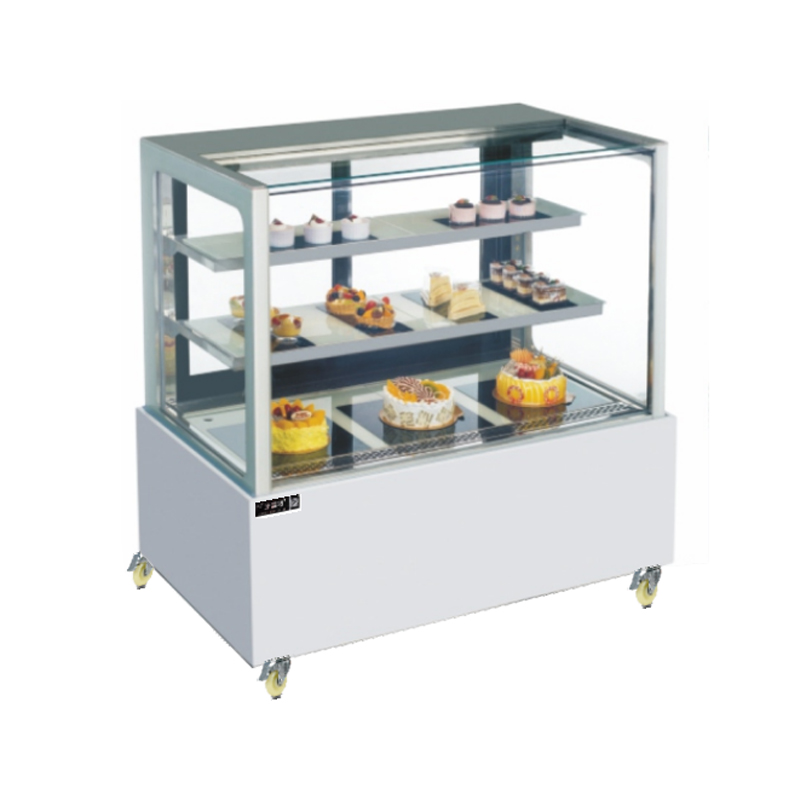 Right-Angle Curved Refrigerated Cake Display CabinetCurved glass and a refrigerated base keep cakes and plated desserts visible and within holding range during long banquet service.View Product →
Ice cream and gelato service is a different job. The cabinet has to keep product at scooping consistency while protecting it from warm room air, and it has to be easy for staff to open, scoop, and close again during a rush. A commercial ice cream dipping cabinet is built around that repeated motion, with storage that keeps the display neat and the product ready to serve.
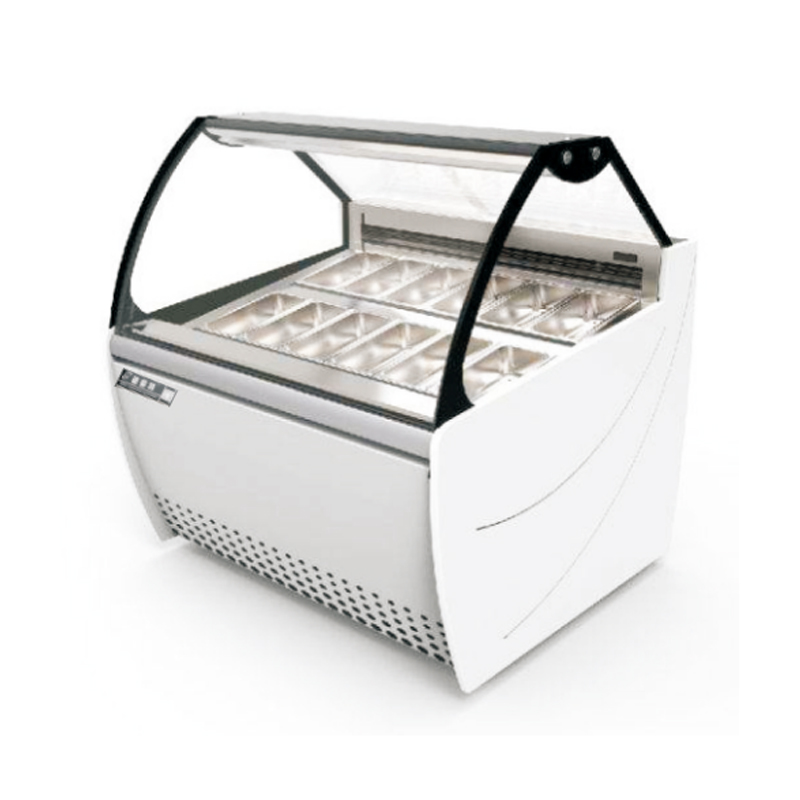 Commercial Ice Cream Dipping Cabinet Display CaseBuilt for repeated scooping during busy service, with low-temperature storage and clear glass that keeps ice cream ready and neatly displayed.View Product →
For salad bars and savory cold stations, the same principles apply: shallow pans, clear labels, and a case that lets guests see what they are choosing without slowing the line. If a full multi-deck case is part of the plan, use it as the main cold display and let smaller cases handle dessert, ice cream, or specialty items nearby.
Stainless steel is common in commercial display equipment for good reasons. It resists corrosion, handles daily cleaning, and keeps a professional look after years of service. Many of our own refrigerators and display cases use 201 or 304 stainless steel, depending on the model and the customer's requirements. The difference matters less than the build quality around it: shelf supports, door seals, hinges, and the finish on edges that staff touch every day.
Cleaning should be planned, not improvised. Warm, soapy water and a soft cloth are usually enough for glass and stainless surfaces, followed by a clean rinse and dry. Avoid spraying water directly into electrical areas or fan openings. Check door gaskets for crumbs and sticky residue, because a poor seal makes the refrigeration system work harder. At the end of service, empty the case, clean the shelves, and leave the interior dry before closing it up.
Our team has been manufacturing commercial refrigeration equipment since 2006, with production in Jiangsu since 2016. Over that time, we have learned that a reliable case is not only about the compressor or the coil. It is also about whether a busy server can clean it in ten minutes, whether the shelves fit the pans already in the kitchen, and whether the case still looks presentable after a hundred banquets.
When you compare banquet buffet multi-deck display options, bring the real operation into the conversation. A few questions will narrow the field quickly:
It also helps to ask for a clear demonstration rather than a catalogue promise. Load the case with the pans you actually use. Watch how a person reaches for the back shelf. Check how the glass looks under the room's lighting. These small tests reveal more than a list of specifications.
A banquet buffet multi-deck display works best when it is treated as part of the service line, not as a separate piece of furniture. Give it the right position, keep the air curtain clear, load it sensibly, and clean it with the same care you give the rest of the kitchen. The result is a buffet that looks generous, moves smoothly, and keeps cold food safely cold from the first guest to the last. If you are planning a new cold station or updating an existing one, our team is always glad to talk through the practical details with you.

No.8 Xinhua Road, Dianshanhu Town, Kunshan City, Suzhou, Jiangsu Province, China
Call Us: +86-18217685733 / +86-18221531811
E-mail: [email protected] / [email protected]
Copyright © Jiangsu Bingluo Refrigeration Equipment Co., Ltd. All Rights Reserved. Commercial Refrigeration Equipment Solutions