 English
 русский
 Español
 عربى
عربىIndustry News
Home / News / Industry News / Why Do Professional Chefs Prefer These Commercial Upright Refrigerators Over All Others?
2026-01-07
Content
Commercial upright refrigerators are engineered to handle the high-stress environment of a professional kitchen, where doors are frequently opened and closed. To maintain a consistent internal temperature, these units utilize forced-air cooling systems. High-velocity fans circulate cold air throughout the cabinet to ensure that even when the unit is fully stocked, there are no "warm spots" that could compromise food safety. Understanding the difference between top-mounted and bottom-mounted compressors is vital; top-mounted units are ideal for cooler environments as they don't suck in dust from the floor, while bottom-mounted units offer easier access for maintenance and better ergonomics for staff reaching the bottom shelves.
The layout of your refrigerator significantly impacts its energy consumption and cooling speed. Overloading shelves or placing large containers directly against the back wall can block air vents, forcing the compressor to work harder and increasing utility costs. Most modern upright refrigerators come with adjustable epoxy-coated wire shelves designed to promote vertical and horizontal airflow. Proper spacing ensures that every item, from delicate garnishes to heavy proteins, remains within the safe temperature zone of 33°F to 40°F (0.5°C to 4°C).
Choosing a refrigerator isn't just about size; it is about meeting rigorous health and safety standards. Commercial-grade units are built with stainless steel interiors and exteriors to resist corrosion and facilitate deep cleaning. Furthermore, digital temperature controllers with external displays are now standard, allowing kitchen managers to monitor internal conditions at a glance without opening the doors. This helps in maintaining the HACCP (Hazard Analysis and Critical Control Points) logs required by health inspectors.
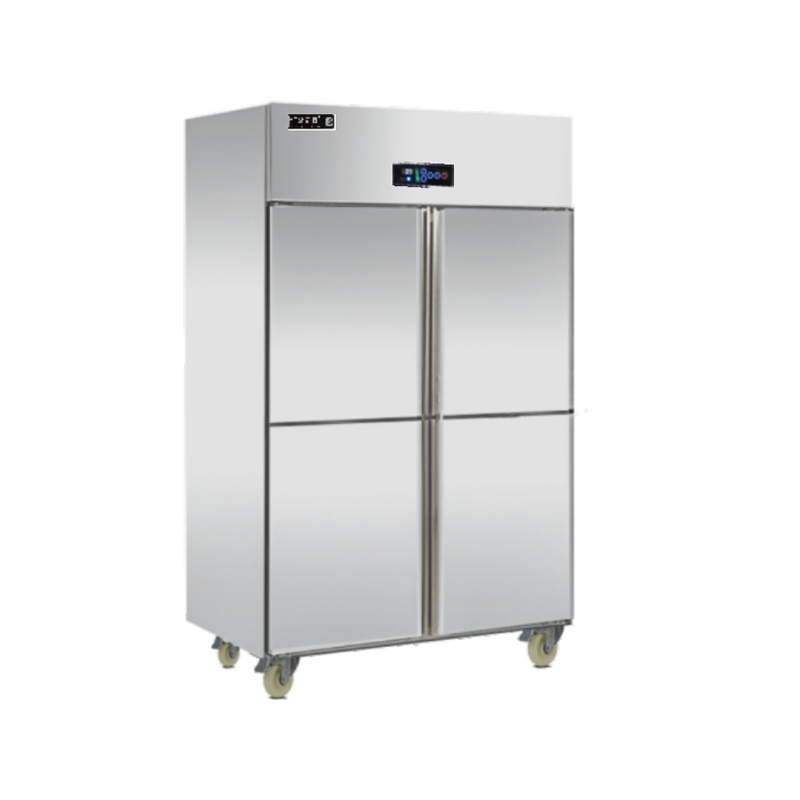
The choice between a solid door and a glass door depends largely on the refrigerator's location and intended use. Solid door models offer superior insulation and are generally more energy-efficient, making them the preferred choice for back-of-house storage. Glass door models, while slightly less efficient due to thermal transfer, allow staff to locate ingredients without opening the door, which can save time during a busy rush and serve as an excellent display for front-of-house beverage service.
| Feature | Solid Door Units | Glass Door Units |
| Insulation Efficiency | Excellent (Higher R-Value) | Moderate (Double/Triple Pane) |
| Visibility | None (Requires Opening) | High (Inventory at a glance) |
| Durability | High (Resistant to Dents) | Moderate (Tempered Glass) |
| Primary Use | Storage / Prep Areas | Merchandising / Quick Access |
To protect your investment, a strict maintenance schedule is necessary. The most common cause of commercial refrigerator failure is a dirty condenser coil. When dust and grease accumulate on the coils, the heat cannot dissipate properly, leading to compressor burnout. Cleaning these coils every 30 to 60 days with a stiff brush or vacuum is one of the simplest ways to extend the life of your equipment. Additionally, checking door gaskets for tears or loss of suction ensures that the motor isn't running constantly to compensate for leaked air.
Staff should be trained to recognize early warning signs of mechanical fatigue. If the refrigerator is making excessive noise, if there is water pooling at the base, or if the temperature fluctuates more than five degrees during off-peak hours, it is time to call a technician. Addressing these issues early prevents the total loss of inventory and avoids the high costs associated with emergency repairs or complete unit replacement.

No.8 Xinhua Road, Dianshanhu Town, Kunshan City, Suzhou, Jiangsu Province, China
Call Us: +86-18217685733 / +86-18221531811
E-mail: [email protected] / [email protected]
Copyright © Jiangsu Bingluo Refrigeration Equipment Co., Ltd. All Rights Reserved. Commercial Refrigeration Equipment Solutions