 English
 русский
 Español
 عربى
عربىIndustry News
Home / News / Industry News / The Unsung Heroes of the Supermarket: How Refrigerated Display Cases Keep Our Food Safe and Fresh
2025-12-24
Content
Every trip to the grocery store involves a silent agreement: the food on the shelves is safe to eat. A critical, yet often-overlooked, player in upholding this trust is the refrigerated display case. These gleaming walls of glass and circulating air are far more than just cold boxes; they are sophisticated applications of thermal engineering, working tirelessly to preserve the quality and safety of everything from dairy and deli meats to fresh produce.
The physics behind these cases is an extension of the same principles that cool your home refrigerator. It relies on the refrigeration cycle, which essentially involves moving heat from inside the case to the outside store environment.
The core components are:
The Compressor: This machine pressurizes a gaseous refrigerant, which raises its temperature.
The Condenser: The hot, pressurized refrigerant flows through coils, typically located at the bottom or top of the case, or remotely outside the store. Here, the refrigerant releases its heat to the surrounding air and condenses back into a high-pressure liquid.
The Expansion Valve: This component suddenly drops the pressure of the liquid refrigerant.
The Evaporator: As the low-pressure liquid flows through the evaporator coils, it quickly absorbs heat from the air inside the display case, turning back into a low-pressure gas. This absorption of heat is what cools the air, which is then circulated over the food products.
This cycle repeats continuously, forming a vital link in the "cold chain" that extends from the farm to your fridge.
Refrigerated display cases come in a surprising variety of designs, each tackling the challenge of cold preservation with a different set of trade-offs, particularly concerning energy use and customer accessibility.
The tall, open shelves used for milk, yogurt, and beverages are perhaps the most recognizable. These are known as multideck display cases and they operate without a physical door. Their entire cooling strategy relies on an "air curtain"—a high-velocity jet of cold air shot across the open front from the top to a return vent at the bottom.
This curtain acts as an invisible, cold barrier, separating the chilled air inside from the warm, moist air of the store aisle. The design is great for impulse shopping and easy access, but it is notoriously energy-inefficient. A significant portion of the case's cooling load comes from constantly battling the infiltration of warm, humid air that "leaks" through the air curtain.
The second major design uses glass doors or lids, most common for frozen foods and specialized products. By creating a physical barrier, these cases dramatically reduce the exchange of air with the warm surroundings. This simple addition can cut the refrigeration load by over 60%, leading to substantial energy savings.
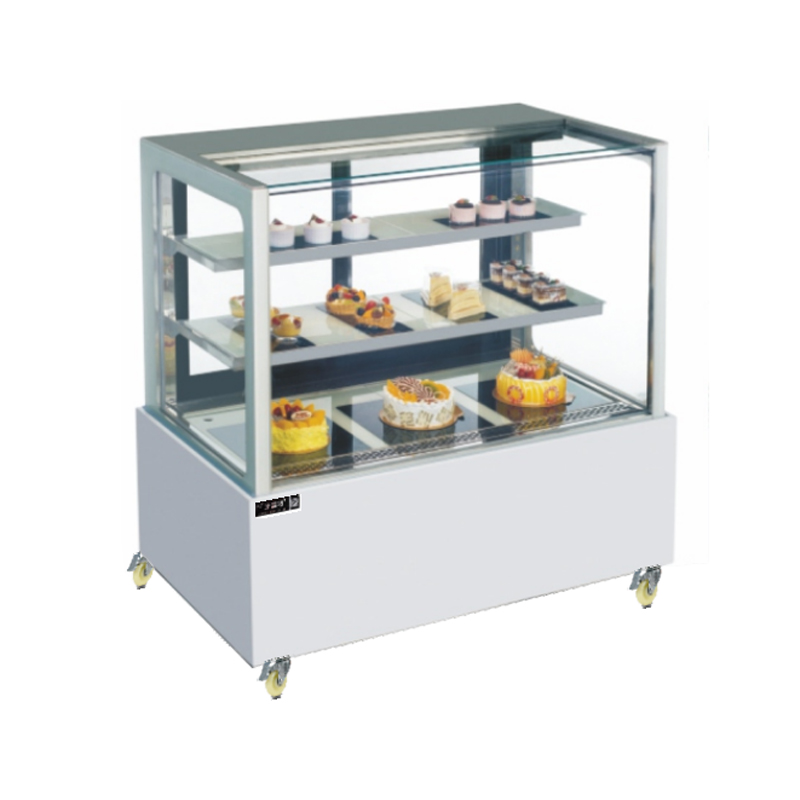
However, the glass presents its own engineering hurdle: condensation. If the outer glass surface drops below the dew point of the store's air, it will fog up, obstructing the view of the product. To combat this, some cases employ low-energy anti-sweat heaters built into the door frames or use specialized anti-fog glass coatings.
The sheer number of refrigerated display cases in a modern supermarket makes them one of the biggest energy consumers in the entire store, often accounting for half of the total electricity bill. This has driven a major movement toward energy efficiency and sustainability.
Innovations are constantly being developed to improve the performance of both open and closed cases:
Aerodynamic Improvements: For open cases, engineers are applying principles from aeronautics—like optimizing the angle and speed of the air curtain—to create a more stable, impenetrable "air barrier" that minimizes warm air infiltration.
LED Lighting: Traditional fluorescent lights emit heat, which the refrigeration system then has to work harder to remove. Replacing these with cool-running LED lights reduces the overall heat load, saving energy directly and indirectly.
Advanced Controls: Modern cases use digital controllers and sensors to precisely manage defrost cycles and adjust cooling capacity based on product temperature, ambient conditions, and even store traffic, maximizing efficiency.
Another massive shift is the move away from older synthetic refrigerants, which have a high Global Warming Potential (GWP), towards natural alternatives like carbon dioxide and hydrocarbons. While the move to requires more complex high-pressure refrigeration systems, it is a crucial step for reducing the environmental impact of the entire food retail sector. The future of the refrigerated display case is a marriage of accessibility, food safety, and advanced thermal science aimed at a more sustainable planet.

No.8 Xinhua Road, Dianshanhu Town, Kunshan City, Suzhou, Jiangsu Province, China
Call Us: +86-18217685733 / +86-18221531811
E-mail: [email protected] / [email protected]
Copyright © Jiangsu Bingluo Refrigeration Equipment Co., Ltd. All Rights Reserved. Commercial Refrigeration Equipment Solutions