 English
 русский
 Español
 عربى
عربىIndustry News
Home / News / Industry News / Commercial Refrigerators: How to Choose, Use, and Maintain the Right One for Your Business
2026-03-25
Content
Commercial refrigerators are purpose-built refrigeration units designed to operate continuously in demanding foodservice, retail, and hospitality environments where domestic refrigerators would fail within months. The differences go far beyond size. A commercial fridge is engineered to maintain precise, consistent temperatures across its entire internal volume even when doors are opened dozens or hundreds of times per hour, when the ambient kitchen temperature exceeds 35°C, and when the unit is packed close to capacity with fresh product that needs rapid chilling. Domestic refrigerators are designed for intermittent domestic use at much lower cycling frequencies and simply do not have the compressor capacity, airflow engineering, or component durability to cope with commercial operating conditions.
The construction standards are also fundamentally different. Commercial refrigeration units use stainless steel interiors and exteriors that resist the physical impacts, chemical cleaning agents, and moisture exposure inherent in professional kitchen environments. The refrigeration components — compressors, evaporator coils, condenser fans — are rated for continuous-duty operation and are sized to maintain temperature recovery after door openings without the prolonged pull-down periods that would result in temperature excursions and food safety violations. Understanding these differences is the starting point for making an informed commercial refrigerator purchasing decision, because applying domestic logic to a commercial refrigeration requirement almost always results in equipment that underperforms, fails prematurely, or creates food safety compliance problems.
Commercial refrigeration equipment encompasses a wide range of unit types, each designed for specific operational contexts, storage volumes, and access requirements. Choosing the right type for the application is as important as choosing the right capacity — the wrong type of unit creates workflow inefficiencies and operational problems regardless of its size or quality.
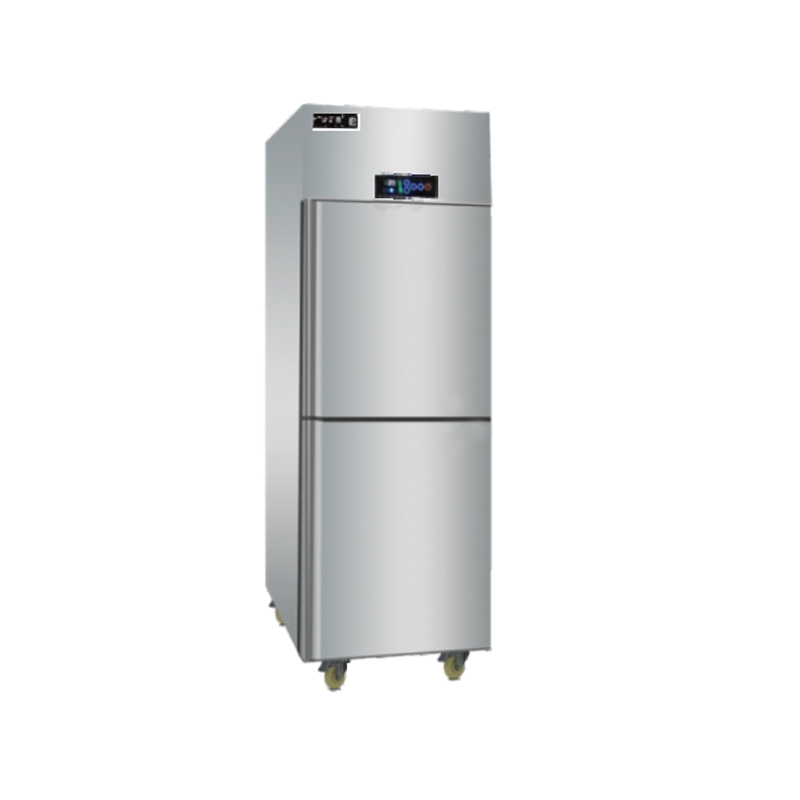
Reach-in commercial refrigerators are the most widely used type in restaurant and foodservice kitchens. They are upright, freestanding units with one, two, or three solid or glass doors, providing large storage capacity in a relatively compact floor footprint. Single-door reach-in units typically offer 20–25 cubic feet of storage; three-section units can exceed 70 cubic feet. Reach-in commercial upright refrigerators are available with the compressor mounted at the top or bottom of the unit — top-mount compressors run cooler and more efficiently but reduce accessible interior height, while bottom-mount compressors are easier to service in a busy kitchen environment but are more vulnerable to grease and debris accumulation that requires more frequent cleaning. Glass-door reach-in units are common in front-of-house beverage and ingredient display applications where visibility is a priority.
Undercounter commercial refrigeration units are compact, low-profile units designed to fit beneath a standard 36-inch work surface, providing refrigerated storage at the point of use in a kitchen workstation. They are standard equipment at cook lines, prep stations, and bar setups where having cold ingredients immediately accessible without walking to a reach-in unit improves workflow efficiency and reduces the frequency with which large-format reach-in units are opened. Undercounter units sacrifice total storage capacity for locational convenience — a typical two-door undercounter unit provides 10–15 cubic feet of storage — but their contribution to kitchen efficiency often outweighs the capacity limitation. Refrigerated prep tables, which combine an undercounter refrigerator with a refrigerated rail for hotel pan inserts at the work surface, are a variant particularly valuable in sandwich, pizza, and salad assembly stations.
Walk-in coolers are large-format commercial refrigeration installations built into or attached to a kitchen or storage facility, allowing staff to walk inside for product storage and retrieval. They are the backbone of high-volume foodservice operations — large restaurants, hotels, catering facilities, and food retail environments — where the storage volume required exceeds what reach-in units can practically provide. Walk-in coolers are constructed from insulated modular panels and fitted with dedicated refrigeration systems, and they can be configured in virtually any size from a small 6x6-foot unit to warehouse-scale refrigerated rooms. The large storage volume and high product throughput of walk-in coolers require more powerful refrigeration systems and more rigorous temperature monitoring than smaller reach-in units, and their installation requires structural and electrical planning that adds to the total project cost beyond the equipment itself.
Display commercial refrigerators are designed for retail environments — convenience stores, supermarkets, delis, bakeries, and cafés — where product visibility and accessibility drive sales as much as cold storage. Open-front merchandiser units provide the highest product visibility and easiest access but consume significantly more energy than closed-door units due to constant cold air loss at the open face. Glass-door reach-in merchandisers balance visibility with energy efficiency and are standard in convenience and grocery retail. Curved glass display cases are used in deli, bakery, and patisserie settings where the refrigerated display case is a key part of the customer-facing service counter. The refrigeration specification for display units must balance maintaining safe product temperatures with preventing condensation on glass surfaces that would obstruct product visibility.
Blast chillers are specialized commercial refrigeration units that rapidly reduce the temperature of cooked or freshly prepared food from serving temperature (around 70°C) to safe storage temperature (3°C or below) within 90 minutes — the maximum time permitted under HACCP food safety guidelines for the chilling step. This rapid chilling process is impossible to achieve safely in a standard reach-in refrigerator, which lacks the refrigeration capacity and airflow to pull down the temperature of hot food quickly enough without raising the entire cabinet temperature to dangerous levels and compromising other stored products. Blast chillers are mandatory equipment in cook-chill foodservice operations and are increasingly required by health inspectors in high-volume kitchens as food safety standards tighten.
Commercial refrigerators are specified across a range of technical parameters that determine their suitability for a specific operational environment. Evaluating these specifications carefully — rather than selecting purely on price or brand — is the most effective way to ensure the equipment meets operational demands throughout its service life.
| Specification | Typical Range | What to Look For |
| Temperature Range | 0°C – 8°C (refrigeration) | Consistent hold at 1–4°C in high-ambient conditions |
| Ambient Temperature Rating | 16°C – 43°C (Class N to Class 5) | Must match the kitchen's actual ambient temperature range |
| Interior Capacity | 5 – 75+ cubic feet | Usable capacity with standard pan and shelf configurations |
| Energy Consumption | 2 – 15 kWh/day depending on size | Energy Star certification for efficiency benchmark |
| Refrigerant Type | R290, R134a, R404A, R448A | R290 (propane) preferred for low GWP compliance |
| Door Configuration | 1, 2, or 3 section; solid or glass | Match to access frequency and visibility requirements |
| Compressor Location | Top-mount or bottom-mount | Bottom-mount easier to service; top-mount more efficient |
| Construction Material | 304 or 430 stainless steel | 304-grade for high-moisture and coastal environments |
The ambient temperature rating of a commercial refrigerator is one of the most frequently overlooked specifications during the purchasing process, and mismatching a unit's ambient rating to the actual kitchen environment is one of the leading causes of commercial refrigerator underperformance and premature failure. The ambient temperature rating defines the range of surrounding air temperatures within which the unit can maintain its specified internal temperature. Commercial refrigerators are classified into climate classes — from Class N (rated for ambient temperatures up to 32°C) through to Class 5 (rated up to 43°C) — and a unit installed in an ambient environment warmer than its rating will run continuously without achieving the target internal temperature, causing the compressor to overheat and fail prematurely while also failing to maintain safe food storage temperatures.
Professional kitchen environments routinely exceed 35°C ambient during peak service periods, particularly near cooking equipment. Any commercial refrigerator installed in a professional kitchen should therefore be rated for at least 38°C ambient — Class 4 or Class 5 — to provide adequate operating margin. Units installed in air-conditioned front-of-house environments, dedicated refrigerated storerooms, or retail spaces with good climate control may operate safely at lower ambient ratings, but it is always safer and more economical over the unit's service life to match or exceed the ambient temperature rating to the actual installation environment rather than to install a marginally rated unit that runs hard continuously.
Commercial refrigerators used in food businesses are subject to food safety regulations that set specific requirements for temperature maintenance, construction standards, and operational monitoring. Compliance with these requirements is not optional — failure to maintain safe food storage temperatures is a food safety hazard that can result in enforcement action, fines, and closure orders from environmental health authorities.
In most jurisdictions, perishable food in commercial refrigerators must be maintained at or below 5°C (41°F in the US) at all times. This requires not just that the refrigerator is set to a target temperature within this range, but that the actual product temperature — not just the air temperature in the cabinet — remains within the safe zone. A refrigerator that consistently holds its air temperature at 3°C but allows product temperature to rise to 7°C during a busy service period with frequent door openings is a food safety problem. When evaluating commercial refrigerators for food safety compliance, look for units with high-efficiency air circulation systems that provide consistent temperature distribution throughout the cabinet volume, rapid temperature recovery after door openings, and accurate digital temperature displays showing actual internal air temperature with logging capability.
HACCP (Hazard Analysis Critical Control Points) food safety management systems require documented evidence that critical control points — including refrigerated storage temperatures — are monitored, recorded, and within defined limits. Most commercial refrigerators used in professionally managed food businesses are fitted with digital temperature displays and alarms that alert staff when the internal temperature exceeds a set threshold. Many modern commercial refrigeration units also include data logging functions that record temperature readings at set intervals throughout the operating day, providing the documented monitoring record required by HACCP systems. For businesses subject to third-party food safety audits — as required by major retailers, food service operators, and hospitality groups — automated temperature logging that exports data to a food safety management software system is increasingly standard rather than optional.
In the United States, commercial refrigerators used in foodservice should carry NSF International certification — particularly NSF/ANSI Standard 7 for commercial refrigerators and freezers — which verifies that the unit meets material safety, construction, and performance standards for food contact environments. In Europe, CE marking confirms compliance with applicable EU directives including low voltage, electromagnetic compatibility, and machinery safety requirements. Some jurisdictions require both NSF and local regulatory certification for commercial equipment installed in permitted food businesses. Always verify that a commercial refrigerator carries the relevant certification for the market where it will be installed and operated before purchasing, as non-certified equipment may not be accepted by environmental health inspectors during licensing or inspection visits.
Commercial refrigerators are among the most energy-intensive pieces of equipment in a commercial kitchen or retail environment, operating continuously 24 hours a day, 365 days a year. The energy cost of running a commercial refrigerator over its 10–15 year service life typically exceeds its purchase price, which means that energy efficiency should be a primary purchasing criterion rather than an afterthought.
Energy Star certified commercial refrigerators — available in both the US and equivalent programs in other markets — consume significantly less energy than standard commercial units. The Energy Star program for commercial refrigerators sets energy consumption limits based on cabinet type and volume, and certified units typically use 20–40% less energy than the minimum regulatory requirement. The payback period on the higher purchase price of an Energy Star certified commercial refrigerator compared to a standard unit is typically two to four years through energy cost savings, after which the efficiency advantage is pure operating cost reduction.
Several design features contribute to the energy efficiency of commercial refrigerators. LED interior lighting uses substantially less electricity than fluorescent tube alternatives and generates less heat inside the cabinet, reducing the refrigeration load. High-density door gaskets with strong magnetic closure strips prevent cold air leakage around door edges. Variable-speed electronically commutated motor (ECM) evaporator fans adjust their speed based on actual refrigeration demand rather than running at fixed speed continuously. Auto-closing door mechanisms prevent the energy waste of doors left inadvertently open. High-efficiency scroll compressors or inverter-driven compressors adjust their output to match actual cooling demand rather than cycling on and off repeatedly. When comparing commercial refrigerators on energy efficiency, request the actual measured kWh per day consumption figure from the manufacturer's test data rather than relying on descriptive claims.
Correct installation is as important as correct equipment selection for commercial refrigerator performance and longevity. Installation errors — inadequate ventilation clearance, incorrect electrical supply, improper leveling, or poor location choice — create performance problems and premature failures that are incorrectly attributed to equipment quality when the root cause is the installation.
Commercial refrigerators are built for durability, but they require regular maintenance to sustain their performance, efficiency, and service life. Most commercial refrigerator failures are either directly caused by deferred maintenance or are significantly accelerated by it. A structured maintenance schedule — carried out consistently by trained kitchen staff supplemented by periodic professional service — dramatically extends equipment life and reduces the total cost of ownership.
Daily maintenance in a commercial kitchen context means inspecting and cleaning the door gaskets every day to remove food debris that prevents full sealing, checking the displayed temperature against the target and investigating any deviation, and wiping down the interior surfaces to prevent food residue accumulation that can harbor bacteria and cause odor. Weekly tasks include cleaning the condenser coils — the most frequently neglected and most impactful maintenance task — by vacuuming or brushing accumulated grease and dust from the condenser fins. A condenser coil with 6mm of dust accumulation causes the refrigerator to consume up to 30% more electricity and operate at significantly reduced capacity. In kitchens with high grease-laden air — near fryers and grills — condenser cleaning may need to be performed more frequently than weekly.
Monthly tasks include inspecting door gaskets for tears, compression loss, or mold growth and replacing any damaged gaskets immediately — a leaking door gasket can increase energy consumption by 10–25% and cause temperature compliance failures. Check and clean the condensate drain line to prevent blockages that cause water to overflow inside the cabinet, creating a hygiene problem and potential electrical hazard. Inspect the door hinges and closing mechanisms for wear and adjust or lubricate them as needed to maintain proper door sealing. Quarterly professional service visits should include refrigerant charge verification, electrical connection inspection, thermostat calibration check, and a comprehensive assessment of compressor and fan motor condition.
Staff should be trained to recognize early warning signs that a commercial refrigerator needs service, so that problems are addressed before they become failures during service. The key indicators that require immediate professional attention include the unit running continuously without cycling off — which indicates the refrigerant charge is low, the condenser is blocked, or the thermostat is faulty; unusual noises from the compressor or fan motors including rattling, grinding, or high-pitched squealing; ice or frost accumulation on the evaporator coils visible when the interior panels are removed — indicating a defrost system failure; water pooling inside the cabinet or on the floor around the unit; and any instance where the internal temperature exceeds the target by more than 2°C for a period of more than 30 minutes.
Choosing the right commercial refrigerator capacity requires a realistic assessment of current and projected storage needs rather than simply buying the largest unit that fits the available space. Both undersized and oversized commercial refrigerators create operational problems — an undersized unit is chronically overstocked, which impairs airflow and temperature uniformity and increases the risk of food safety incidents, while an oversized unit uses more energy than necessary and may be difficult to maintain properly with the available floor space and ventilation arrangement.
A practical starting point is to calculate the peak storage volume required — the maximum quantity of perishable product that will be in the unit simultaneously during the busiest period of the week. This includes not just the current week's product but also buffer stock for delivery delays and the product that arrives on delivery day before older stock is used. Convert product quantities to standard hotel pan or GN container volumes — the unit of measure that commercial refrigerator interior configurations are based on — and then select a unit with sufficient shelf capacity to hold this volume with product organized properly, with clear labeling visible, and with adequate airflow around products so that the refrigeration system can maintain temperature uniformity throughout the cabinet.
A common recommendation for restaurant kitchens is to budget approximately 1–1.5 cubic feet of reach-in refrigeration per seat for full-service restaurants, with additional capacity for walk-in cold storage for bulk stock. This is a rough guideline only — actual requirements vary significantly based on menu complexity, delivery frequency, and the proportion of fresh versus frozen product used. Operations that receive daily deliveries need less refrigeration storage capacity than those receiving twice-weekly deliveries, because less stock needs to be held on-site at any one time. Accurate capacity planning based on actual stock holding requirements consistently produces better operational outcomes than rules-of-thumb applied without reference to the specific operation's workflow.

No.8 Xinhua Road, Dianshanhu Town, Kunshan City, Suzhou, Jiangsu Province, China
Call Us: +86-18217685733 / +86-18221531811
E-mail: [email protected] / [email protected]
Copyright © Jiangsu Bingluo Refrigeration Equipment Co., Ltd. All Rights Reserved. Commercial Refrigeration Equipment Solutions