 English
 русский
 Español
 عربى
عربىIndustry News
Home / News / Industry News / Commercial Milk Frothers: How to Choose the Right One for Your Coffee Business
2026-05-26
Content
A commercial milk frother is purpose-built for the demands of a professional coffee environment — continuous operation across multiple service hours, consistent output across hundreds of drinks per day, and reliability under the physical and thermal stress that high-volume service places on equipment. These are fundamentally different performance requirements from a home milk frother designed for five or ten uses per day, and the gap between consumer and professional frothing equipment is reflected in build quality, motor specifications, heating capacity, durability of seals and valves, and the depth of control available over frothing temperature and texture.
For cafes, coffee shops, hotel breakfast service operations, restaurant breakfast and brunch menus, and any food service environment where steamed and frothed milk is a core product output, the quality and consistency of milk texturing is as commercially important as the espresso itself. A professional milk steamer or automated milk frother that produces inconsistent microfoam, overheats milk, or requires frequent recalibration creates a bottleneck in drink preparation and undermines the quality standard a business has built its reputation on. Understanding the full range of commercial milk frothing equipment — what each type does, how it differs, and which applications each suits — is the starting point for making a well-informed equipment purchase.
The commercial milk frothing equipment market encompasses several distinct machine categories, each suited to a different service model, volume level, and degree of operator skill required. The right choice depends on your drink menu, throughput requirements, available counter space, and whether manual barista control or automated consistency is the priority.
The steam wand integrated into a commercial espresso machine is the traditional and still most widely used milk frothing tool in specialty coffee environments. Steam is generated in the espresso machine's boiler and delivered through a wand at pressures typically between 1 and 1.5 bar, which the barista uses to simultaneously heat and aerate milk in a stainless steel pitcher. When used correctly, a quality steam wand in skilled hands produces the silkiest, most consistent microfoam of any frothing method — the fine, uniform bubble structure that integrates smoothly with espresso and allows precise latte art. The limitation is that steam wand texturing is entirely operator-dependent: two baristas using the same machine will produce noticeably different results unless both are well trained and consistent in their technique, and training to a high standard takes time and ongoing coaching.
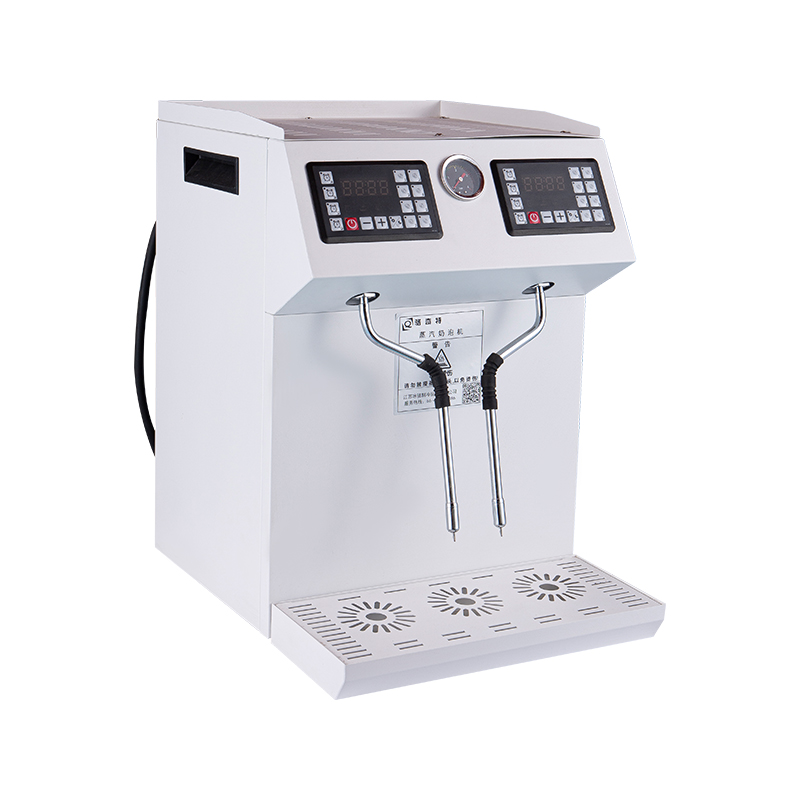
Automatic commercial milk frothers — also referred to as automatic milk steamers or automatic milk texturizers — are standalone machines that heat and froth a metered dose of milk to a programmed temperature and texture at the press of a button, without requiring barista technique. The operator selects the drink type (cappuccino, latte, flat white), places the pitcher or cup under the delivery nozzle, and the machine delivers a precisely controlled output. Leading automatic frothing systems used in commercial environments include brands such as Nuova Simonelli's Latte Art machine, the Mavam Espresso system, and superautomatic espresso machine integrated milk systems from Schaerer, Franke, and WMF. These systems are particularly well suited to high-volume operations where drink consistency across a large team of operators — including those with minimal barista training — is more important than the craft variability of hand-steamed milk.
Standalone commercial electric milk frothers are countertop units that heat milk in an internal vessel using an electric heating element and create froth through a whisk or spinning disk mechanism. Unlike steam-based frothing, these units do not require a boiler or steam pressure — they operate independently of an espresso machine and can be positioned anywhere on the counter with access to a standard power outlet. Commercial electric frothers in this category — such as the Jura milk frother systems, the Nespresso Aeroccino Pro, and similar professional-grade units — operate at faster cycle times than consumer equivalents and are built for daily multi-use service. They are most appropriate for operations that serve a moderate volume of milk-based drinks and want a consistent, easy-to-operate solution that does not require barista steam wand training.
For very high-volume commercial environments — hotel breakfast buffets serving hundreds of covers per hour, large corporate cafeterias, and stadium or event catering — bulk milk dispensing and frothing systems connected directly to refrigerated milk supply lines represent the highest throughput tier of commercial milk frothing equipment. These systems integrate refrigerated storage, dosing, heating, and frothing in a single unit with minimal manual intervention between drinks. Systems in this category from suppliers such as Cimbali, Franke, and Melitta Professional are designed to be integrated into fully automated coffee stations and are specified in large commercial fitout projects rather than purchased as standalone retail items.
When assessing commercial milk frother options against each other and against your specific operational requirements, the following technical and operational specifications are the most meaningful to compare:
| Specification | What to Look For | Why It Matters |
| Cycle Time (seconds) | 20–45 sec for automatic systems; continuous for steam wands | Determines maximum drink throughput per hour; slow cycle times create queue bottlenecks during peak service |
| Temperature Control | Programmable target temperature ±2°C accuracy | Overheated milk (above 70°C) scalds and loses sweetness; under-heated milk fails food safety thresholds in some markets |
| Milk Volume Range | Adjustable from 60ml to 400ml+ depending on drink menu | A machine that cannot dose the full range of milk quantities on your menu requires manual intervention that slows service |
| Foam Texture Adjustment | Selectable foam density for cappuccino, latte, flat white | Different drink styles require different foam-to-liquid ratios; a single foam setting cannot serve a full milk drink menu consistently |
| Non-Dairy Milk Compatibility | Oat, almond, soy, and coconut milk performance testing | Non-dairy milks behave differently from cow's milk under heat and aeration; not all frothers produce acceptable microfoam with plant-based alternatives |
| Cleaning System | Automatic cleaning cycle; CIP (Clean-in-Place) compatibility | Milk residue left in tubes and valves spoils quickly and creates hygiene and flavor contamination risks; easy cleaning is essential for food safety compliance |
| Power Consumption | 1,500W–3,500W typical for standalone commercial units | Affects operating cost and whether the unit can run on a standard circuit or requires a dedicated high-amperage connection |
| Warranty and Service Network | Minimum 1-year parts and labor; local authorized service | A commercial milk frother failure during peak service without rapid repair support directly impacts revenue and customer experience |
The quality of milk texturing produced by a commercial milk frother is more nuanced than simply "frothy" or "not frothy." In specialty coffee, microfoam quality — the structure, stability, and integration of the air bubbles introduced during frothing — is a craft standard that directly affects the flavor, mouthfeel, and visual presentation of every espresso-based milk drink. Understanding the components of texturing quality helps evaluate whether a commercial frothing system will meet your specific product standard.
Microfoam is a milk texture where air has been incorporated into the milk in the form of microscopic bubbles so fine and uniform that the milk takes on a glossy, paint-like consistency — it pours smoothly, integrates with espresso evenly, and supports latte art because the surface tension created by the fine bubble structure holds patterns. Macrofoam — the type produced by whisk-based electric frothers and lower-quality steam technique — consists of larger, irregular bubbles that sit on top of the milk like meringue, drain liquid quickly, and produce a dry, airy cappuccino texture that cannot be poured smoothly or used for latte art. For specialty coffee operations where microfoam quality is part of the product offer, only steam-based or high-end automated texturing systems produce results that meet the standard. For operations where a traditional dry cappuccino foam is acceptable or preferred, electric whisk-based commercial frothers are a practical and cost-effective solution.
The temperature at which milk is frothed profoundly affects both the quality of the foam produced and the flavor of the finished drink. The proteins in milk — particularly casein and whey — denature progressively as temperature rises, and it is this denaturation that stabilizes the air bubbles introduced during frothing into a foam structure. Below 55°C, the proteins are not sufficiently denatured to produce stable foam, and the milk texture collapses quickly. Above 70°C, the lactose in milk begins to cook and caramelize, the proteins over-denature and the foam becomes coarse and unstable, and the milk takes on a scalded, bitter flavor. The optimal frothing range for cow's milk is 60°C to 68°C — within this window, foam stability is high, lactose sweetness is at its peak, and the flavor integrates cleanly with espresso. Commercial milk frothers with precise programmable temperature control allow operators to target this range consistently across every drink, which manual steam wand technique only achieves with experienced baristas using thermometers or calibrated temperature-sensing pitchers.
Oat milk, almond milk, soy milk, and other plant-based dairy alternatives have become a significant portion of milk-based drink orders in most commercial coffee environments, and the frothing behavior of these milks differs substantially from whole or semi-skimmed cow's milk. Oat milk designed as a barista formulation — with higher fat and stabilizer content than retail oat milk — produces the closest approximation to cow's milk microfoam and integrates well with espresso. Standard retail oat milk froths adequately but produces a thinner foam that breaks down faster. Almond milk is the most challenging alternative for frothing — its low fat and protein content means foam structure is fragile and the beverage window before the foam separates is short. Soy milk froths reasonably well when it is fresh and at the right temperature but can split in contact with acidic espresso if not incorporated immediately. For commercial operations with significant non-dairy milk demand, testing your specific commercial milk frother with the exact non-dairy milks on your menu — not just with cow's milk — before purchase is an important validation step that many buyers skip.
Milk is one of the highest-risk food hygiene materials in a commercial kitchen or cafe environment. It provides an ideal growth medium for pathogens including Listeria, Salmonella, and Staphylococcus aureus when left at temperatures between 5°C and 60°C — the danger zone range that encompasses everything from room temperature to warm-but-not-hot. Any commercial milk frothing system that has internal passages, nozzles, or vessels where milk can pool and cool creates a hygiene risk if it is not cleaned completely and promptly at appropriate intervals.
The right commercial milk frothing equipment for one type of operation is often exactly wrong for another. Volume, staff skill level, drink menu complexity, available counter space, and budget all factor into finding the best fit. The following framework helps match machine type to operational context:
Operations built on specialty coffee craft — where latte art, microfoam quality, and barista skill are central to the brand — should prioritize a commercial espresso machine with a high-performance dual boiler or heat exchanger steam wand over any automatic milk frothing alternative. The steam wand gives skilled baristas full control over the texturing process and is the only tool that consistently produces competition-quality microfoam. The investment in barista training that a steam-wand-based operation requires is substantial, but it creates the quality differentiation that justifies specialty pricing and builds a loyal customer base that values craft.
For coffee operations serving 200 to 500 or more milk drinks per day with a team of mixed skill levels — including part-time staff with limited barista training — automatic commercial milk frothers or superautomatic espresso systems with integrated milk frothing deliver better consistency across the team than manual steam wand operation. The consistency trade-off compared to expert manual technique is real but manageable: modern automatic frothing systems produce a good-quality textured milk that the majority of consumers rate as excellent, even if it doesn't reach the peak quality ceiling of an expert barista working manually. The operational benefits — shorter training times, faster service, and predictable output — are significant at this volume level.
Hotels serving breakfast milk drinks, restaurants offering a coffee menu as a supporting rather than primary service, and any venue where coffee is one item in a broad F&B operation rather than the core product are ideal candidates for standalone commercial electric milk frothers or fully automated coffee machines with integrated frothing systems. These environments typically lack dedicated barista staff, cannot invest heavily in coffee-specific training, and need a solution that any team member can operate to a consistent standard. Automatic commercial milk frothers in the 1,500–2,500W range, capable of producing 60–180 drinks per hour, are well matched to this operational profile.
Commercial milk frothing equipment spans a very wide price range — from a few hundred dollars for a quality standalone commercial electric frother to tens of thousands for a fully integrated automatic milk system built into a premium superautomatic espresso machine. Understanding what drives pricing differences helps set realistic budget expectations and identify where spending more genuinely delivers operational value versus where a lower-cost option performs comparably.
Before committing to a commercial milk frothing machine purchase, whether buying direct from a manufacturer, through a coffee equipment distributor, or via a leasing agreement, the following questions help confirm that the equipment will perform as needed in your specific operation and that the commercial relationship with the supplier is sound:

No.8 Xinhua Road, Dianshanhu Town, Kunshan City, Suzhou, Jiangsu Province, China
Call Us: +86-18217685733 / +86-18221531811
E-mail: [email protected] / [email protected]
Copyright © Jiangsu Bingluo Refrigeration Equipment Co., Ltd. All Rights Reserved. Commercial Refrigeration Equipment Solutions