 English
 русский
 Español
 عربى
عربىIndustry News
Home / News / Industry News / Brushed Steel Bar Counters: The Complete Guide to Choosing, Installing, and Maintaining Them
2026-05-19
Content
Brushed steel bar counters have earned a permanent place in both commercial hospitality spaces and high-end residential bar setups — and for good reason. The brushed finish, achieved by grinding the steel surface in a single direction to create fine, parallel lines, gives the metal a soft, satin-like appearance that reads as refined rather than cold or industrial. Unlike polished stainless steel, which shows every fingerprint and scratch in sharp relief, a brushed stainless steel bar counter hides daily wear remarkably well while still delivering the clean, contemporary look that professional bars demand.
From craft cocktail bars and hotel lobbies to kitchen islands repurposed as home bars, the brushed steel bar top has become a material of choice for designers who want durability without sacrificing aesthetics. The surface is non-porous, highly resistant to moisture and staining, and doesn't require sealing or periodic refinishing the way wood, concrete, or natural stone countertops do. For any space where spills, heat, and heavy use are a daily reality, a brushed stainless steel bar counter is one of the most practical investments available.
Not all brushed steel finishes look the same, and the variation comes down to the abrasive grit used during the grinding process and the direction of the brush lines. Understanding finish designations helps you order the right surface and set accurate expectations for how it will look installed.
The most common finish for commercial and residential bar counters, the #4 brushed finish is produced with 120–180 grit abrasives, resulting in moderately fine parallel lines. It has a warm, matte-satin look and is highly effective at masking scratches and smudges. This is the finish you'll find on most professional-grade stainless steel bar tops, commercial kitchen surfaces, and restaurant counters. It strikes the ideal balance between scratch resistance and visual appeal.
Produced with finer abrasives, the #6 finish has a softer, slightly shinier appearance than #4 without crossing into mirror-polish territory. It's used in upscale bar and hospitality environments where the design brief calls for a more premium feel. The finer brush lines are slightly more susceptible to visible scratching over time compared to the #4, but the overall aesthetic is noticeably more luxurious.
Most brushed steel bar counters feature a horizontal brush pattern running along the length of the top surface — this is the standard orientation and aligns visually with the long axis of the bar. Some custom fabricators offer cross-brushed or circular brushed (engine-turned) patterns for a more distinctive look. Cross-brushed finishes, where the grain runs in two perpendicular directions, are particularly effective at camouflaging wear from all directions and are increasingly popular in high-traffic bar environments.
The stainless steel grade is just as important as the finish. The grade determines corrosion resistance, durability, and suitability for the environment the bar counter will live in. Here are the grades most commonly used in brushed steel bar counter fabrication:
| Grade | Composition | Best For | Corrosion Resistance |
| 304 Stainless | 18% chromium, 8% nickel | Indoor bars, restaurants, home bars | Good (not for saltwater) |
| 316 Stainless | 18% chromium, 10% nickel, 2% molybdenum | Outdoor bars, coastal environments | Excellent (marine grade) |
| 430 Stainless | 17% chromium, no nickel | Budget builds, light-use applications | Moderate |
| Duplex 2205 | 22% chromium, 5% nickel, 3% molybdenum | High-stress commercial applications | Superior |
For the vast majority of indoor bar counters — whether in a restaurant, hotel, or residential setting — 304-grade brushed stainless steel is the industry standard and offers an excellent balance of performance and cost. If the bar is outdoors, near a pool, or in a coastal area where salt air is a factor, upgrading to 316-grade marine stainless is strongly recommended and worth the additional cost.
Steel gauge (thickness) has a direct impact on how rigid, durable, and premium a brushed steel bar counter feels and performs. Thinner gauges flex under load, transmit sound easily, and dent more readily; thicker gauges are heavier, more solid-feeling, and significantly more resistant to damage.
For bar counter applications, the following gauge guidelines apply:
Many fabricators also apply a sound-deadening undercoating to the underside of brushed steel bar tops, which absorbs vibration, reduces the hollow "drumming" sound when items are placed on the surface, and adds a layer of thermal insulation. If you're sourcing a brushed stainless steel bar counter for a quiet or intimate environment, specifying an underlayment coating is a detail worth requesting.
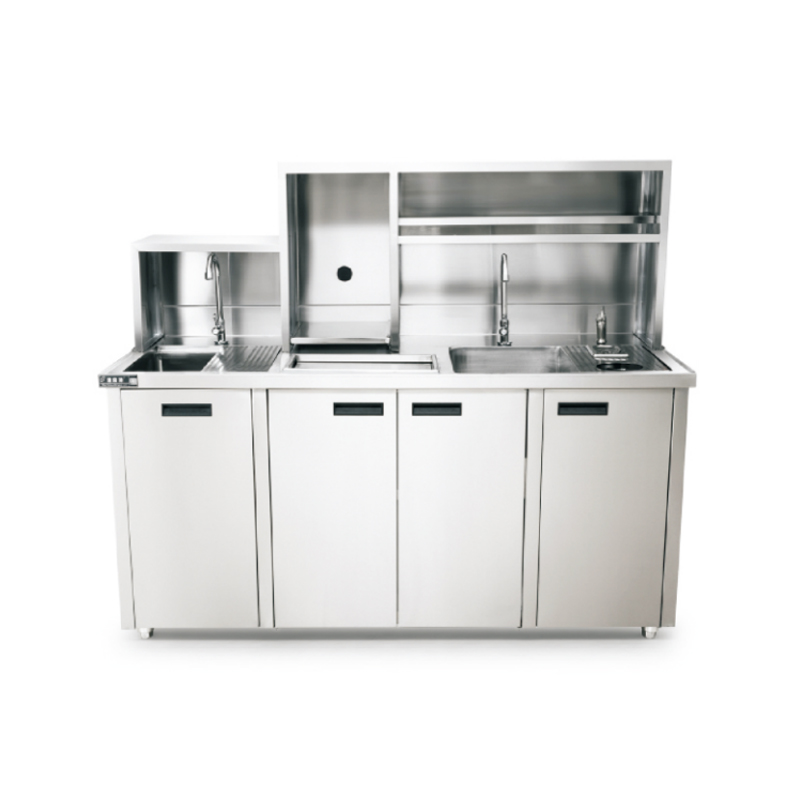
The shape and edge treatment of a brushed steel bar counter has a significant impact on both the visual character and practical functionality of the finished installation. Fabricators typically offer a range of standard configurations that can be adapted to suit the bar's design intent.
The most common configuration for commercial brushed stainless steel bar counters. The top surface is flat, and the front and side edges are folded downward to create a clean, finished apron. The depth of the turned-down edge (typically 50–100 mm) defines how much of the bar front is covered by the steel panel. This design protects the substrate and gives the bar a cohesive, all-steel appearance from the front.
A bullnose edge — where the front edge is rounded into a smooth, continuous curve — makes the bar counter more comfortable for guests leaning against it and reduces the risk of sharp-edge injuries. This is especially important in venues where customers stand at the bar for extended periods. Radius edges can be fabricated to varying degrees of curve depending on the aesthetic brief.
Custom brushed steel bar counters can be fabricated with integrated drainage channels, recessed sink basins, and ice well cutouts as part of a single welded unit. Having these features built into the countertop rather than added as separate components creates a seamless, professional-grade surface with no joints or gaps where bacteria or liquid can accumulate — a major practical advantage in commercial bar environments.
Many brushed stainless steel bar counter designs incorporate a matching footrail or armrest rail as part of the same fabrication. A brushed steel bar rail running along the front face of the counter unifies the design and is far more durable than chrome-plated brass rails, which are the traditional alternative. Integrated rails also eliminate the bracket hardware that independent rail systems require, giving the installation a cleaner finish.
Choosing between a brushed stainless steel bar counter and alternative materials involves trade-offs in aesthetics, maintenance, durability, and cost. Here's how brushed steel stacks up against the most common alternatives:
| Material | Durability | Maintenance | Heat Resistance | Typical Cost |
| Brushed Steel | Excellent | Very low | Excellent | Medium–High |
| Hardwood | Good | High (refinishing) | Poor | Medium |
| Granite / Stone | Excellent | Medium (sealing) | Excellent | High |
| Quartz (Engineered) | Very Good | Low | Good | Medium–High |
| Concrete | Good | High (sealing) | Excellent | Medium |
| Laminate | Moderate | Low | Poor | Low |
Brushed steel bar counters consistently outperform most alternatives in environments where hygiene, heat exposure, and moisture resistance are priorities. The main trade-off compared to natural materials like wood or stone is warmth and tactile variation — brushed steel has a more uniform, contemporary character that suits modern and industrial design languages but may not align with a traditionally styled pub or rustic bar aesthetic.
Installing a brushed stainless steel bar counter is more straightforward than stone or concrete but still requires careful preparation to avoid damaging the surface finish and to ensure a stable, level result. The following process applies to most standard commercial and residential brushed steel bar top installations:
One of the biggest practical advantages of a brushed stainless steel bar counter is how little it demands in terms of routine maintenance. With the right approach, keeping the surface looking clean and professional takes minimal effort.
For everyday cleaning, wipe the brushed steel bar top down with a damp microfibre cloth, always moving in the direction of the grain (along the brush lines, not across them). Follow with a dry cloth to prevent water spots. For bar environments where sticky residues from spilled drinks are common, a small amount of dish soap diluted in warm water is entirely safe and effective. Rinse and dry thoroughly. This simple routine prevents the mineral deposits and residue buildup that make stainless steel look dull over time.
For periodic deep cleaning or to refresh the appearance of a heavily used brushed steel bar counter, a dedicated stainless steel cleaner and polish — applied with a cloth moving strictly along the grain — can remove buildup and restore the original satin sheen. Commercially available stainless steel refinishing kits using progressively finer abrasive pads can also re-blend light surface scratches back into the original grain pattern, effectively resetting the appearance of the surface without professional intervention. This is one of the key advantages brushed steel has over polished finishes, which cannot be re-blended by non-specialists.
Brushed stainless steel bar counters are available through several channels, from off-the-shelf commercial kitchen suppliers to fully custom fabrication shops. Understanding where your needs fall in that spectrum will help set realistic budget expectations.
Standard flat-top brushed steel bar counter panels in common sizes (typically sold by the linear metre) from commercial catering suppliers are the most cost-effective option for straightforward, rectangular installations. These are produced in high volumes, use consistent 304-grade steel at 14 or 16 gauge, and arrive with pre-finished edges and turned-down fronts. They're a solid choice for commercial bars on a budget or for home bar builds where customization isn't needed.
Custom brushed stainless steel bar counters — shaped to non-standard dimensions, incorporating radius corners, integrated drains, sink cutouts, or matching rail systems — are fabricated to order by specialist metalwork shops. Lead times typically range from two to six weeks depending on complexity, and pricing scales with surface area, gauge, and the number of custom features. When requesting quotes, ensure you specify the steel grade, gauge, finish grit, edge profile, and whether sound-deadening underlayment is required.
When evaluating quotes, watch for the following markers of quality fabrication:

No.8 Xinhua Road, Dianshanhu Town, Kunshan City, Suzhou, Jiangsu Province, China
Call Us: +86-18217685733 / +86-18221531811
E-mail: [email protected] / [email protected]
Copyright © Jiangsu Bingluo Refrigeration Equipment Co., Ltd. All Rights Reserved. Commercial Refrigeration Equipment Solutions