 English
 русский
 Español
 عربى
عربىIndustry News
Home / News / Industry News / The Real Guide to Refrigerated Display Cases: How to Pick, Place, and Maintain the Right One for Your Business
2026-05-12
Content
Refrigerated display cases are far more than food storage units — they are the frontline sales tool of any food retail or foodservice operation. Unlike back-of-house storage coolers engineered purely for preservation, display cases are built to do two jobs simultaneously: keep perishables at safe holding temperatures and present those products in the most compelling visual way possible. The glass panels, LED shelf lighting, and open-access designs are all deliberate sales features, not afterthoughts.
The commercial impact is well documented. Self-service refrigerated displays have been shown to increase impulse sales by at least 50% compared to staff-served alternatives, simply because quick and easy access to chilled product lowers the barrier to purchase. Research cited by The Food Institute found that 58% of shoppers say they tried a new snack item because the product looked appealing in the case — meaning your display cooler is doing active marketing work every minute the store is open. For operators in grocery, convenience, bakery, deli, or café settings, choosing the right refrigerated display case is a revenue decision, not just a refrigeration one.
The category spans a wide range of formats, and each is engineered for a specific product type, customer interaction model, and volume level. Understanding the distinctions prevents the common mistake of buying a generic unit that doesn't perform well for your specific application.
Open-air display cases — also called open-front coolers or multi-deck merchandisers — have no doors or glass barriers on the customer-facing side. Products are fully accessible without any handle to pull or door to hold, which maximizes impulse grab behavior in high-traffic settings. An air curtain, a continuous stream of cooled air flowing across the open front, maintains the internal temperature by creating an invisible thermal barrier between the cold cabinet interior and the warmer store environment. These units are the standard format in grocery store produce and dairy aisles, convenience store grab-and-go sections, gas station forecourt coolers, and cafeteria drink stations. The tradeoff is energy consumption: because cold air is continually lost into the ambient store environment, open-air cases work significantly harder than closed-door units, particularly in warm or poorly air-conditioned spaces.
Glass-door merchandisers are enclosed units with one, two, or three transparent doors that allow full product visibility while keeping cold air sealed inside. The enclosed design makes them substantially more energy efficient than open-air alternatives, and they are less sensitive to ambient store temperature and humidity conditions. Available in configurations from 27 inches wide (single door) to 78 inches wide (three-door), these units are the standard format for beverage coolers in convenience stores, bottled water and juice displays in grocery, and pre-packaged deli or snack sections across all retail types. Self-closing door hinges are standard on quality units; anti-condensation glass prevents the door sweating that obscures product visibility in humid environments.
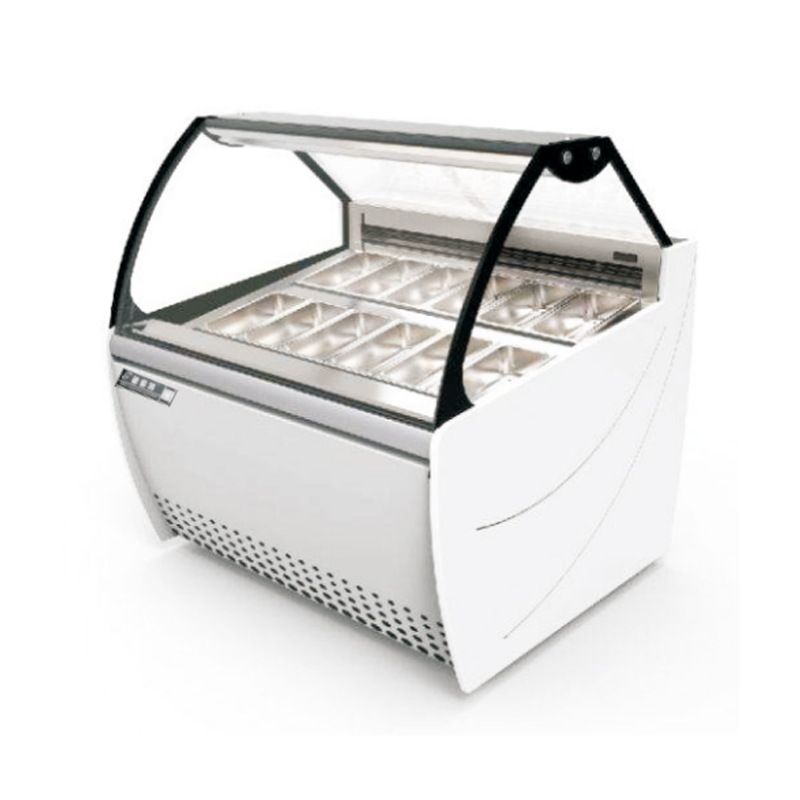
Deli display cases are typically horizontal, countertop-height units staffed from the back by an employee who retrieves and portions product for the customer. They are the standard format for fresh-cut meats, sliced cheese, prepared salads, seafood, and charcuterie. Most deli cases use gravity-coil refrigeration — a cooling coil positioned at the top of the cabinet allows cold air to fall gently over the product below without a fan that would dry out exposed cut meats and fresh items. Deli cases hold product between 33°F and 41°F (0.5°C–5°C), the safe holding range for TCS (Temperature Control for Safety) foods per the FDA Food Code. Glass profiles include straight-front (easier cleaning and maintenance, practical for high-volume delis) and curved-front (more dramatic visual merchandising effect, common in specialty and premium food retailers).
Bakery display cases occupy a unique position: many baked goods — croissants, unfilled loaves, cookies — do not require refrigeration, while cream-filled pastries, mousse cakes, fresh fruit tarts, and custard items do. Refrigerated bakery cases typically maintain temperatures between 35°F and 40°F (2°C–4°C) with optional humidity control to prevent baked goods from drying out under constant refrigeration airflow. Combination units that provide both an ambient-temperature zone and a refrigerated zone give bakeries the flexibility to merchandise both categories without running two separate units. Horizontal countertop configurations are most common in patisseries and cafés; full-height upright cases with multiple shelves appear in bakeries with high product variety and volume.
Countertop display cases are compact, typically 24 inches wide, and designed to sit on an existing counter or service surface rather than requiring dedicated floor space. They are the practical choice for smaller cafés, juice bars, hotel lobbies, and food concessions where space is constrained but refrigerated merchandising is still needed. Applications include single-serve desserts, sushi and sashimi, sliced fruit cups, prepared sandwiches, and specialty beverages. Despite their compact footprint, quality countertop units include the same features as full-size cases: glass panels for visibility, LED shelf lighting, and thermostatically controlled refrigeration holding product at safe temperatures throughout service hours.
| Type | Typical Temp Range | Access Style | Best Application | Energy Use |
|---|---|---|---|---|
| Open-Air Merchandiser | 33°F–41°F (0.5°C–5°C) | Open front (air curtain) | Grocery, convenience, cafeteria grab-and-go | Higher |
| Glass-Door Merchandiser | 33°F–41°F (0.5°C–5°C) | Self-closing glass doors | Beverage, packaged deli, convenience retail | Lower |
| Deli / Full-Service Case | 33°F–41°F (0.5°C–5°C) | Staff-served from rear | Cut meats, cheese, seafood, prepared salads | Moderate |
| Bakery / Pastry Case | 35°F–40°F (2°C–4°C) | Glass front, staff or self-serve | Cream pastries, cakes, patisserie | Moderate |
| Countertop Display Case | 33°F–41°F (0.5°C–5°C) | Glass front | Café, hotel, concession, small deli | Low–Moderate |
Every refrigerated display case runs on one of two refrigeration system configurations — self-contained or remote — and the choice between them has significant implications for installation cost, operating environment, noise levels, and long-term energy expense. This is one of the least-discussed but most consequential decisions in commercial refrigeration procurement.
A self-contained display case houses all refrigeration components — compressor, condenser, and evaporator — within the cabinet itself. This makes it essentially plug-and-play: the unit arrives ready to operate, requires only a standard electrical connection (typically 115V/15A for smaller units, or 208–230V for larger cases), and can be positioned anywhere within reach of a power outlet. Self-contained cases are the standard choice for restaurants, flower shops, cafés, small delis, and any operation with one to a handful of cases. The main drawbacks are that the compressor and condenser emit heat and noise directly into the store interior, which can raise ambient temperatures and create background noise in customer-facing areas. In poorly ventilated spaces, this heat load can also make the refrigeration unit work harder, reducing efficiency.
Remote display cases separate the evaporator (inside the case) from the condensing unit (installed outside the building or in a rooftop mechanical room). Refrigerant lines connect the two components. This configuration removes all compressor heat and noise from the store interior, which keeps the sales floor more comfortable and quieter — a significant advantage in large grocery stores, supermarkets, and multi-case operations. Remote cases also offer more internal display space per unit footprint, since no compressor components occupy the lower cabinet area. The tradeoff is installation complexity and cost: remote cases require professional refrigeration contractors to install the piping, and the units cannot be easily relocated once connected. They are the standard choice for large-scale retail with multiple case lineups, where a centralized rack refrigeration system serves all cases simultaneously.
For operators with one to four cases — a café, small convenience store, specialty food shop, or deli counter — a self-contained unit is almost always the right choice: lower upfront cost, faster setup, and easier maintenance with fewer external components to service. For operators with five or more cases, a central retail grocery operation, or a facility with documented heat and noise concerns in the retail space, remote systems deliver meaningful long-term savings in energy and HVAC load and create a better customer environment. Remote units are also significantly quieter — a relevant consideration in open-concept, customer-facing environments where compressor noise would intrude on the shopping experience.
Manufacturer datasheets list dozens of specifications, but a handful of features have outsized importance for day-to-day performance, food safety, energy costs, and merchandising effectiveness. These are the details worth scrutinizing before finalizing a purchase.
A refrigerated display case is only as good as its ability to hold product at a consistently safe temperature. The FDA Food Code 2022 requires cold TCS (Temperature Control for Safety) foods to be held at 41°F (5°C) or below throughout the service period — not just when first loaded. Verify with a calibrated thermometer at the start of each service shift, not just by reading the external display. Look for units with electronic temperature controllers (more reliable than mechanical thermostats), digital temperature readouts, and high-temperature alarms that alert staff if the unit drifts above the safe holding threshold. Defrost timer settings affect both food safety and energy efficiency: a case defrosting too frequently wastes energy; one defrosting too infrequently develops ice buildup that degrades cooling performance. Quality commercial cases allow operators to configure defrost cycles to match their usage patterns.
Lighting inside a display cooler does more than illuminate the product — it defines the merchandising impact. LED lighting has become the strong preference over fluorescent for three reasons: LEDs last significantly longer, consume less power, and generate far less heat inside the case. Heat from lighting is a refrigeration load — every watt of light-generated heat inside the case is a watt the compressor must remove. Fluorescent bulbs also emit a color spectrum that can make some food categories appear less vibrant. Shelf-mounted LED strips, which illuminate each tier of product individually rather than a single top-mounted light attempting to reach lower shelves, provide significantly better color rendering and visual depth — both proven factors in customer engagement and impulse purchase rates. When comparing units, check whether lighting runs on 120V (standard outlet) or requires a dedicated circuit, and whether replacement bulbs or strips are readily available from the supplier.
The glass panel is the product's first impression on the customer. Curved glass panels maximize the viewing area and create a more dramatic presentation, which is why they appear most often in premium deli and bakery cases. Straight glass is easier to clean, more forgiving in tight spaces, and slightly better for self-service configurations where customers reach through to select items. Anti-fog or heated glass is worth specifying for any unit in a high-humidity environment or one subjected to frequent temperature swings (near an entrance, close to a kitchen exhaust, or in a store without climate control). Condensation on the glass obscures the product and signals a poorly performing unit to customers — both outcomes are bad for sales.
Adjustable shelves allow operators to reconfigure the case as product mix changes — a critical feature for delis with rotating seasonal offerings or retailers who change promotional stock frequently. Shelf materials vary: stainless steel shelves are the most durable and cleanable; epoxy-coated wire shelves provide good visibility and airflow between products; glass shelves offer a premium presentation but require more careful cleaning. Check the weight rating per shelf, especially for dense products like glass-bottled beverages or bulk prepared foods. Cases with a high number of straight shelves are ideal for high-volume operations; smaller units with fewer, deeper shelves work better for select specialty offerings. Some manufacturers offer side-by-side connecting cases that create an uninterrupted display run for large supermarket or deli counter applications.
Commercial refrigerated display cases run continuously, every hour of every day. ENERGY STAR certified commercial refrigerators are on average 20% more energy efficient than non-certified models, according to the U.S. EPA — a difference that compounds into substantial savings over the life of a unit. For an open-air case running 24 hours, the annual energy cost difference between a certified and non-certified unit can be significant enough to offset a portion of the price premium in a few years. Additionally, look for units specifying eco-friendly refrigerants such as R290 (propane-based), which have a global warming potential (GWP) dramatically lower than older HFC refrigerants. Energy-efficient features to confirm: low-heat LED lighting, insulated glass (double or triple-pane for freezer applications), electronically commutated motors (ECMs) on evaporator fans, and night covers for open-air cases to reduce losses during non-operating hours.
There is no universal best refrigerated display case — the right choice depends on what you sell, how customers interact with the product, and how much floor or counter space you can allocate. Here is how the decision maps to common business types.
Large retail grocery operations typically run a mix of open-air multi-deck cases for produce, dairy, and prepared foods (where accessibility and high product visibility drive impulse sales) and glass-door reach-in merchandisers for beverages and pre-packaged items (where energy efficiency is the priority). Combination cases — units that offer both a refrigerated and ambient-temperature section in one cabinet — have become increasingly common for grab-and-go sections that stock both refrigerated sandwiches and ambient-temperature chips or snacks side by side. Full-service deli cases anchor the fresh protein and specialty cheese sections. For operations this size, remote condensing is typically the better long-term investment to manage heat load, noise, and total energy spend across a large case count.
Convenience stores depend heavily on beverage sales, which makes glass-door reach-in merchandisers the primary case type. Typically positioned at the back or along side walls to encourage customers to walk the full store, these units need to be visually compelling from a distance — well-lit, densely stocked, and clearly organized. A smaller open-air or countertop grab-and-go case near the register captures impulse add-on purchases at the point of sale. Self-contained units are standard for this application due to the plug-and-play installation requirement and the typically small-to-medium case count per location.
A full-service deli counter is the operational and visual centerpiece of a deli. The refrigerated display case here needs to showcase product in the most appealing way possible while maintaining precise temperature control for raw proteins and prepared items. Gravity-coil refrigeration is the preferred system because it cools product gently from above without the drying airflow that damages exposed cut meats and salads. If the operation also carries packaged takeaway items and beverages, a glass-door merchandiser alongside the service case captures that business without pulling staff attention. Straight glass cases are the standard for service delis; curved glass is chosen when premium presentation justifies the additional cleaning complexity.
Cafés and bakeries have a mixed product challenge: some offerings (croissants, biscotti, unfilled bread) are displayed at ambient temperature, while others (cream tarts, mousse slices, dairy-based beverages) require refrigeration. Combination cases that offer both zones in one unit are the practical solution here, eliminating the need for two separate displays in a space where counter real estate is always limited. Countertop refrigerated display cases are ideal for smaller cafés — they add a significant visual merchandising element at the counter without consuming floor space. Keep these units away from heat sources (espresso machines, panini presses, ovens) and direct sunlight, both of which create heat loads that force the refrigeration system to work harder and can cause temperature inconsistency across the shelves.
Where a refrigerated display case is positioned in a store affects its performance as much as which unit you buy. Poor placement decisions create ongoing temperature maintenance problems, accelerated wear on the refrigeration system, and higher energy bills — all entirely preventable.
Commercial refrigerated display cases run continuously and require a structured maintenance schedule to sustain performance, pass health inspections, and avoid the kind of compressor or evaporator failures that result in costly emergency repairs and product loss. Most issues that cause display case failures are traceable to neglected routine maintenance, not to equipment defects.

No.8 Xinhua Road, Dianshanhu Town, Kunshan City, Suzhou, Jiangsu Province, China
Call Us: +86-18217685733 / +86-18221531811
E-mail: [email protected] / [email protected]
Copyright © Jiangsu Bingluo Refrigeration Equipment Co., Ltd. All Rights Reserved. Commercial Refrigeration Equipment Solutions