 English
 русский
 Español
 عربى
عربىIndustry News
Home / News / Industry News / Air Cooled Commercial Ice Maker: A Practical Buying Guide for Business Owners
2026-07-01
Content
An air cooled commercial ice maker uses ambient air, pulled through a condenser by a fan, to dissipate heat from the refrigeration cycle and produce ice continuously throughout the day. This is one of two main cooling methods used in commercial ice machines, the other being water cooled systems that rely on a constant water supply to remove heat instead of air. For most restaurants, bars, cafes, hotels, and convenience stores, an air cooled commercial ice maker is the more practical choice because it doesn't require a dedicated water line for cooling, doesn't generate ongoing water waste, and is generally simpler to install in standard commercial kitchen environments. Understanding why cooling method matters upfront helps buyers avoid the common mistake of comparing ice machines purely on ice production numbers without factoring in how the unit actually operates day to day.
While air cooled units are generally easier to install and operate, their performance is more directly affected by the surrounding environment than water cooled alternatives. Buyers should understand these performance factors before placing the unit in a specific location.
Since the unit relies on pulling in surrounding air to cool the condenser, ice production capacity drops as ambient temperature rises. A machine rated to produce a certain amount of ice per day at 70°F will produce noticeably less in a hot kitchen environment running closer to 90°F or higher. This is why manufacturer spec sheets typically list production rates at multiple ambient temperatures, and buyers should always check the rating that matches their actual installation environment rather than relying on the headline number.
Air cooled units need adequate space around the condenser to draw in cool air and exhaust hot air effectively. Placing the machine in a tight, enclosed space without proper clearance causes the unit to recirculate its own hot exhaust air, which reduces efficiency and increases wear on the compressor over time. Most manufacturers specify a minimum clearance distance on all sides, and ignoring this during installation is one of the most common causes of underperformance complaints.
Buyers researching commercial ice making equipment often need a direct comparison between the two cooling methods to make an informed decision based on their specific facility conditions and operating costs.
| Factor | Air Cooled | Water Cooled |
| Installation Requirements | No dedicated water line needed | Requires constant water supply line |
| Water Usage | Lower overall water consumption | Higher water usage, often restricted in some regions |
| Performance in Hot Environments | Output drops in high ambient heat | More stable output regardless of ambient temperature |
| Best Suited For | Standard kitchens with normal ventilation | Hot climates or poorly ventilated spaces |
An air cooled ice machine can typically be configured to produce different ice types, and the right choice depends heavily on how the ice will actually be used in your operation. Picking the wrong ice type is a common oversight that affects both customer experience and operating efficiency.
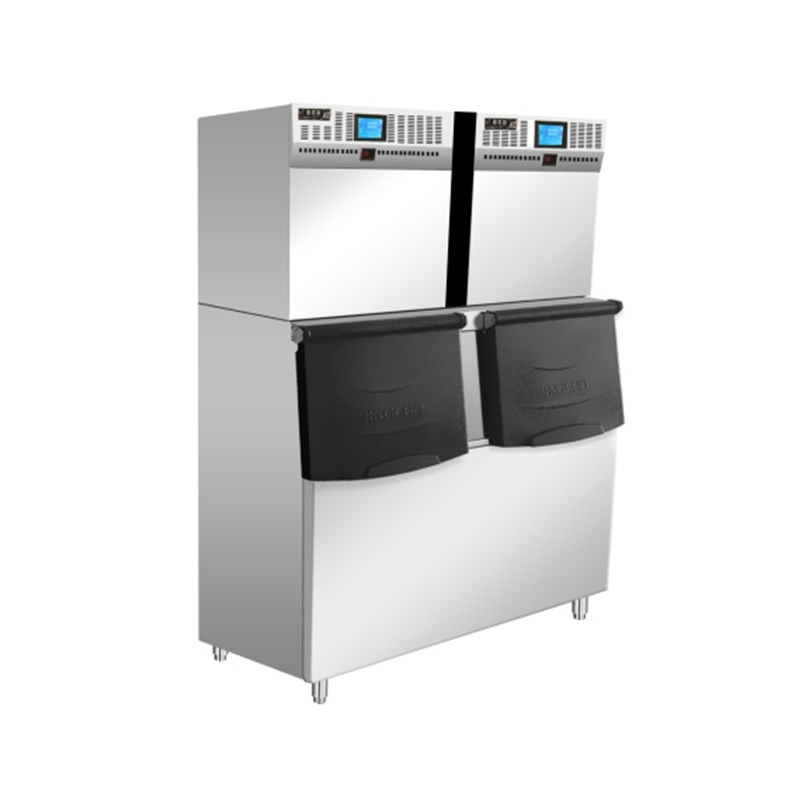
Selecting an air cooled commercial ice maker with the right daily output capacity is one of the most important sizing decisions buyers face, since undersizing leads to ice shortages during peak hours while oversizing wastes both upfront cost and ongoing energy consumption. Capacity should be estimated based on realistic peak-day demand rather than average daily usage, since most foodservice operations experience significant swings between slow periods and busy hours.
| Business Type | Typical Daily Output Needed |
| Small Cafe or Coffee Shop | 100–200 lbs/day |
| Mid-Size Restaurant or Bar | 300–600 lbs/day |
| Large Restaurant, Hotel, or Banquet Hall | 800–1,500+ lbs/day |
Regular maintenance has a particularly strong impact on air cooled units, since dust and grease buildup on the condenser coils directly reduces the machine's ability to dissipate heat efficiently. Businesses that follow a consistent maintenance routine generally avoid the gradual output decline that often gets mistaken for equipment failure.
Before finalizing a purchase, buyers should confirm specific details with suppliers rather than relying solely on general product descriptions, since real-world performance often varies based on installation conditions and water quality.
Choosing the right air cooled commercial ice maker comes down to matching capacity, ice type, and installation conditions to your actual business environment rather than selecting based on price or headline output numbers alone. Buyers who account for ambient temperature impact, confirm proper ventilation clearance, and plan for realistic peak-demand capacity tend to avoid the ice shortages and premature equipment wear that come from mismatched purchasing decisions. Since ice production directly affects daily operations in food and beverage service, taking the time to verify these details upfront pays off in long-term reliability and consistent performance.

No.8 Xinhua Road, Dianshanhu Town, Kunshan City, Suzhou, Jiangsu Province, China
Call Us: +86-18217685733 / +86-18221531811
E-mail: [email protected] / [email protected]
Copyright © Jiangsu Bingluo Refrigeration Equipment Co., Ltd. All Rights Reserved. Commercial Refrigeration Equipment Solutions