 English
 русский
 Español
 عربى
عربىIndustry News
Home / News / Industry News / -25°C Deep Freeze for Meat Transport: A Practical Cold Chain Guide for Exporters
2026-09-23
Meat is one of the least forgiving cargoes in the cold chain. A few degrees of drift, a door held open a minute too long, or a pallet waiting on a warm dock can turn a shipment that left the plant in perfect condition into cargo that arrives soft, streaked with purge and worth far less than it should be. That is why so many processors, exporters and butchers we talk to set their working temperature at -25°C rather than the more familiar -18°C. It costs a little more energy to hold, but it buys a margin of safety that pays for itself the first time a truck is late.
This guide walks through what -25°C deep freeze actually does for meat, where the other temperature bands fit, and the equipment habits that keep a load solid from the first pallet to the last delivery.
Content
At -18°C, most of the water in meat is frozen, but not all of it. A small fraction stays liquid, carrying dissolved salts and proteins, and that unfrozen fraction is where slow chemistry keeps working. Enzymes continue to break down tissue, fats continue to oxidise, and over months of storage the difference shows up as duller colour, weaker flavour and heavier drip loss when the meat finally thaws.
Drop the set point to -25°C and that unfrozen fraction shrinks dramatically. Enzyme activity slows to a crawl, microbial growth stops entirely, and the tissue holds its structure far better over long storage. The other half of the story is freezing speed. Fast freezing forms small ice crystals inside the muscle fibres; slow freezing forms large ones that puncture cell walls, and those punctured cells release their liquid as purge the moment the meat is thawed. For export programmes and long sea voyages, where product may sit frozen for six months or more, -25°C is often the difference between a premium-grade arrival and a claim.
It is worth saying plainly that -25°C is not a magic number. What it really represents is a deliberate buffer, an operating point far enough below the product's critical threshold that ordinary door openings, defrost cycles and loading gains never push the meat itself past the safe line.
Most meat logistics conversations get tangled because people use the word frozen to cover several very different regimes. Here is how the bands usually break down in practice.
| Band | Set Point | Typical Use | Cost of Drift |
|---|---|---|---|
| Chilled | 0 to +4°C | Fresh cuts, short local delivery | Bacterial growth resumes; days of shelf life lost in hours |
| Super-chilled | -1 to -2°C | Fresh meat held near its freezing point | Partial freezing, surface discolouration, uneven texture |
| Standard frozen | -18°C | General frozen storage and retail | Fine for short cycles, weaker for long storage |
| Deep freeze | -25°C | Export meat, long holds, premium cuts | Higher energy and insulation demand |
| Ultra-low | -30 to -40°C | Speciality seafood and processed proteins | Costly, rarely justified for ordinary red meat |
Notice that only the last two rows are true deep freeze. If a supplier quotes deep freeze and then stores at -18°C, the product is frozen but not deep frozen, and the storage-life assumptions behind the price no longer hold.
A common mistake is treating the storage room as the place where freezing happens. Cold rooms are built to hold a temperature, not to pull heat out of warm product quickly. If pallets of fresh meat go straight into a -25°C store, the room temperature climbs, the compressors run flat out, and the outer layer of every pallet freezes slowly, which is exactly the large-crystal scenario you were trying to avoid.
The cleaner sequence is to pull heat out fast in a blast chiller or blast freezer, then move the product into deep-freeze storage where it only has to be held. Rapid chilling also protects food safety, because the window in which meat sits inside the bacterial growth range shrinks from many hours to a couple.
 Commercial Blast Chiller/FreezerThe Commercial Blast Chiller/Freezer can rapidly freeze products from room temperature to a center temperature of -18℃ in approximately 180 minutes, preserving the fre...View Product →
Choosing the right capacity comes down to daily throughput, product thickness and how much of your production is already pre-chilled. A unit that is too small simply becomes a bottleneck, and staff start skipping it. If you are still settling on everyday numbers, our note on what temperature a commercial freezer should hold covers the basics in plain terms.
Even a perfectly specified deep-freeze room can be undone by the way it is loaded. Cold air has to move, and the meat has to give it somewhere to go.
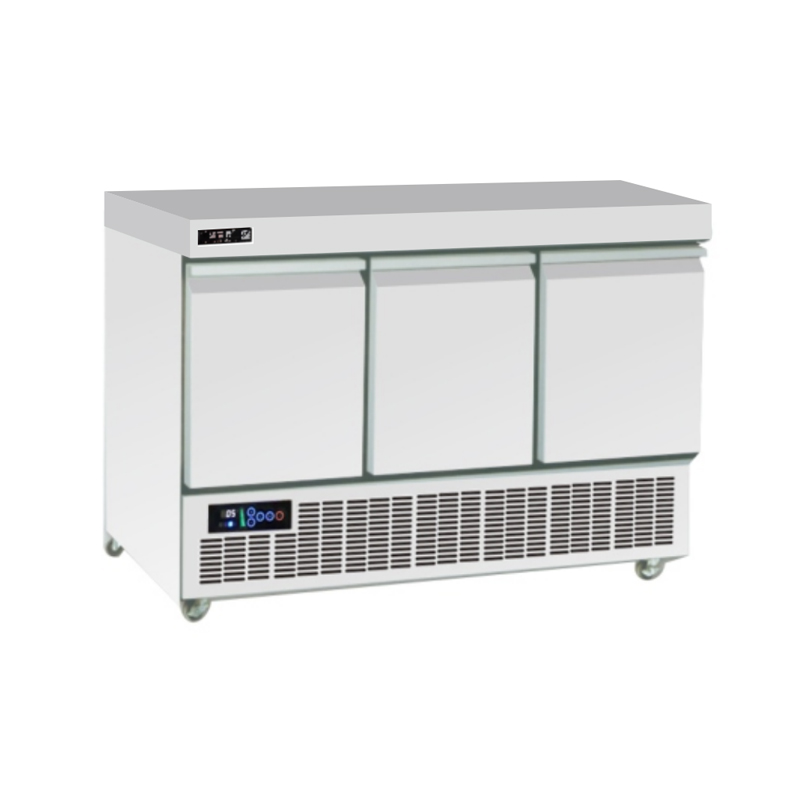
 201/304 Stainless Steel Air-cooled Commercial RefrigeratorThe Air-cooled Commercial Refrigerator features an LED digital temperature control system with intelligent temperature adjustments for precise and stable cooling, ensu...View Product →
For smaller operations, a butcher counter, a prep kitchen or a shop breaking down primal cuts, a horizontal air-cooled unit gives you a working surface and a deep cold store in a single footprint, and it holds temperature while you work through a carcass.
Deep freeze at -25°C leaves less headroom than standard frozen storage. A room running at -18°C can lose its compressor for an hour and still be inside its safe band. A room at -25°C has further to climb and less time to spare.
That makes three things non-negotiable: a temperature record you actually review, an alarm that reaches a person rather than a log file, and a written plan for a power failure. On the equipment side, door gaskets, panel thickness and evaporator condition matter more as the set point drops, because every small heat gain has to be removed again by a compressor that is already working harder.
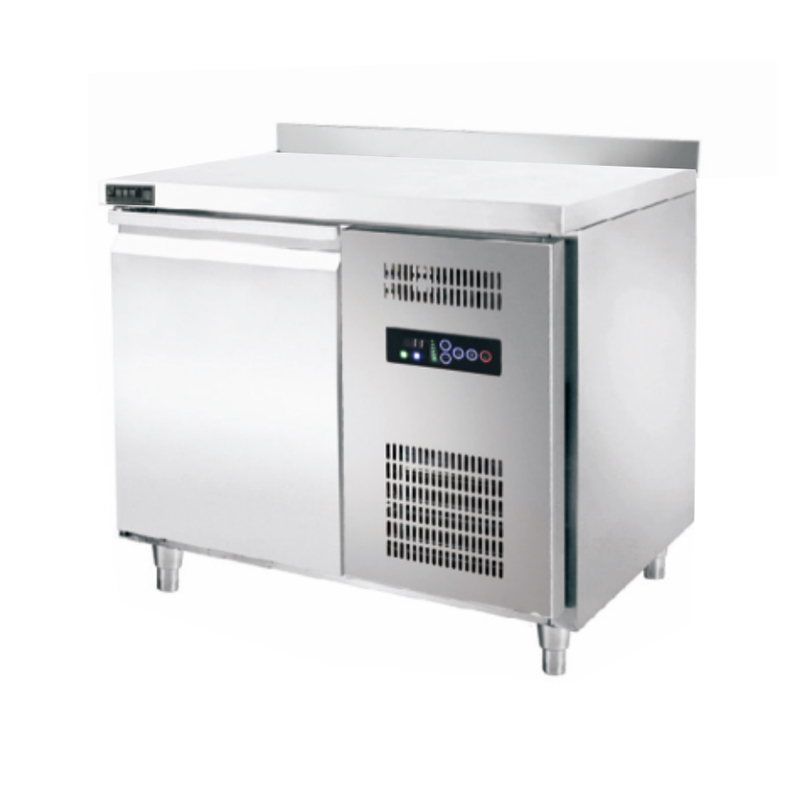
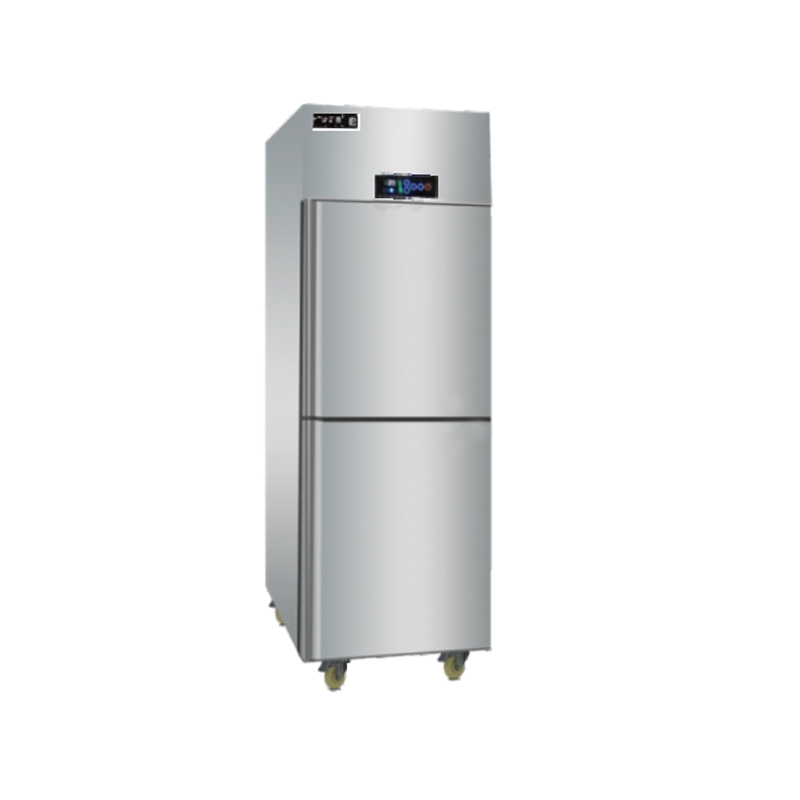 Commercial 201/304 Stainless Steel Upright Air-cooled RefrigeratorThe Upright Air-cooled Commercial Refrigerator features an LED digital temperature control system that enables intelligent temperature adjustments, providing precise c...View Product →
For facilities that need both bulk holding and quick access to smaller quantities, an upright air-cooled cabinet keeps a tight band and takes up very little floor space.
There is no single correct deep-freeze setup. A butcher shop moving a few hundred kilos a week needs something very different from an export plant loading forty-foot containers. What matters is that freezing capacity, holding capacity and airflow are sized for the same throughput, so nothing becomes a queue.
In practice, that usually means a fast-freezing stage for incoming product, deep-freeze holding for buffer stock, and dependable door discipline between the two. If you want to compare how different cabinets and cold rooms fit together, our commercial refrigeration lineup groups the options by storage style and application.
Twenty years of building refrigeration equipment has taught us one simple lesson: cold is cheap, claims are not. Holding meat at -25°C is a decision about margin as much as temperature. Get the freezing speed, the airflow and the monitoring right, and the set point does the rest of the work for you.

No.8 Xinhua Road, Dianshanhu Town, Kunshan City, Suzhou, Jiangsu Province, China
Call Us: +86-18217685733 / +86-18221531811
E-mail: [email protected] / [email protected]
Copyright © Jiangsu Bingluo Refrigeration Equipment Co., Ltd. All Rights Reserved. Commercial Refrigeration Equipment Solutions