 English
 русский
 Español
 عربى
عربىIndustry News
Home / News / Industry News / Restaurant Refrigerators: A Complete Buyer's Guide to Choosing the Right One for Your Kitchen
2026-04-15
Content
Restaurant refrigerators are purpose-built commercial refrigeration units designed to operate continuously in the demanding environment of a professional kitchen — a setting that is fundamentally different from a home kitchen in almost every measurable way. Where a household refrigerator opens perhaps a dozen times a day and holds a modest quantity of food, a commercial restaurant refrigerator may be opened hundreds of times per shift, loaded with heavy sheet pans and bulk ingredient containers, and expected to recover temperature within minutes of a busy service rush. The compressors, insulation, door seals, shelving systems, and control electronics in commercial units are all engineered to a significantly higher specification than residential appliances.
Beyond raw durability, commercial kitchen refrigerators must comply with food safety regulations that mandate specific temperature ranges, recovery times, and sometimes documentation capabilities. In most jurisdictions, food service equipment must carry NSF (National Sanitation Foundation) certification or equivalent, confirming that materials, construction, and cleanability meet public health standards. Using residential refrigerators in a commercial food service operation is not only impractical — it is typically a health code violation. Understanding what separates commercial refrigeration from domestic appliances is the foundation for making the right equipment choices for any food service operation.
The commercial refrigeration market offers a wide range of unit types, each optimized for a specific role in the restaurant kitchen workflow. Choosing the right type — or combination of types — for your operation depends on your menu, kitchen layout, service volume, and the way your team works the line during service.
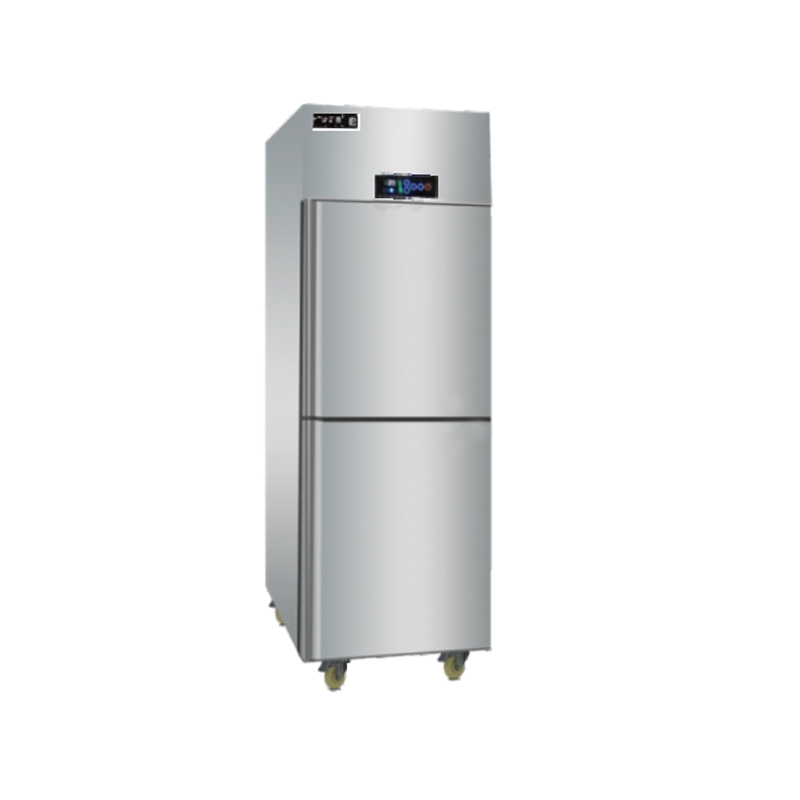
Reach-in refrigerators are the most common and versatile type of commercial restaurant refrigerator. They resemble tall upright cabinets with one, two, or three solid or glass doors, and they are the backbone of back-of-house cold storage in restaurants of all sizes. Full-size reach-in units typically provide 20–25 cubic feet of interior storage per door section, making a three-door reach-in capable of holding a substantial quantity of prepped ingredients, dairy products, proteins, and prepared dishes. Reach-in commercial refrigerators are available in top-mount and bottom-mount compressor configurations — top-mount units are easier to service and keep the compressor away from floor-level heat and dirt, while bottom-mount units place the compressor at a more accessible height for smaller kitchens and provide a more stable temperature distribution from top to bottom of the cabinet.
Undercounter refrigerators are compact units designed to fit beneath a standard 36-inch work surface, placing cold storage exactly where cooks need it on the preparation or cooking line. These units are indispensable in line kitchens where space is at a premium and speed of service demands that ingredients are within arm's reach rather than across the kitchen in a walk-in. Commercial undercounter refrigerators are available in one, two, and three-door configurations and are built to accept gastronorm (GN) pans directly, eliminating the need to transfer food between containers. Some undercounter units are designed as sandwich prep tables or pizza prep tables, combining refrigerated storage below with a refrigerated rail and cutting board surface on top for assembly of dishes during service.
Walk-in coolers are large refrigerated rooms — built on-site from insulated panel systems — that serve as the primary bulk cold storage for high-volume restaurant and food service operations. A walk-in cooler can store hundreds or even thousands of pounds of food product on adjustable wire shelving or in rolling rack systems, making it the hub of a restaurant's cold chain management. Walk-in coolers are available in a wide range of sizes from small pass-through units suitable for a fast-casual restaurant to warehouse-scale refrigerated rooms for large institutional kitchens. The refrigeration system for a walk-in can be a self-contained unit mounted above the door, a remote condensing unit located on the roof or outside the building, or a central refrigeration rack serving multiple coolers and freezers.
Refrigerated prep tables — including sandwich prep tables, pizza prep tables, and salad prep units — combine a refrigerated base cabinet with a refrigerated top rail that holds ingredient pans (typically 1/3, 1/6, or 1/9 GN pans) at working height for rapid assembly during service. The cutting board work surface sits between the operator and the ingredient rail, creating an ergonomic workflow for high-volume assembly of sandwiches, salads, pizzas, and other composed dishes. These units are line-specific workhorses that keep ingredients cold while placing them at exactly the right position for fast, consistent production during peak service periods.
Back bar refrigerators are designed for the specific environment of a bar or beverage station, combining cold storage for bottles, kegs, and canned beverages with a durable construction that withstands the high ambient temperatures near cooking equipment and the constant use of a busy bar service. Display refrigerators — including glass-door reach-ins and curved-glass display cases — serve a dual function of cold storage and visual merchandising, allowing customers to see and select chilled beverages, desserts, or grab-and-go items. Display refrigerators are common in cafés, juice bars, delis, and fast-casual restaurants where the product display itself drives sales.
With dozens of manufacturers and hundreds of models on the market, narrowing down the right commercial refrigerator for your restaurant requires evaluating specific technical specifications against your operational requirements. The following parameters are the most important to compare:
| Specification | What It Means | What to Look For |
| Interior capacity (cu ft) | Usable storage volume inside the unit | Match to your daily prep and storage volume needs |
| Temperature range (°F / °C) | Operating temperature the unit maintains | 33–41°F (0.5–5°C) for standard refrigeration |
| NSF/ANSI certification | Confirms food safety compliance of materials and design | Required for commercial kitchen use in most jurisdictions |
| Compressor location | Top-mount or bottom-mount affects serviceability and temp uniformity | Top-mount preferred for hot kitchen environments |
| Energy Star rating | Indicates energy efficiency above minimum standards | Energy Star models save 20–30% on electricity costs |
| Door type | Solid doors conserve energy; glass doors allow visual inventory | Solid for back-of-house; glass for display or bar use |
| Refrigerant type | Affects environmental impact and regulatory compliance | R-290 (propane) or R-134a preferred; R-404A being phased out |
| Ambient temperature rating | Maximum room temperature where unit can maintain spec | Must exceed your kitchen's ambient temperature at peak hours |
Food safety is the non-negotiable foundation of every decision about restaurant refrigeration equipment. The FDA Food Code, adopted in whole or part by most state and local health authorities in the United States, requires that potentially hazardous foods — those capable of supporting bacterial growth — be maintained at 41°F (5°C) or below during cold storage. Similar requirements exist under EU food hygiene regulations and equivalent standards in other jurisdictions. The temperature danger zone, between 41°F and 135°F (5°C and 57°C), is where bacteria including Salmonella, E. coli, and Listeria can multiply rapidly, and food left in this range for more than four cumulative hours must be discarded.
Commercial restaurant refrigerators must not only achieve the required temperature under static conditions but must recover to safe temperatures quickly after repeated door openings during service — a capability that distinguishes professional units from household appliances, which may struggle to recover temperature quickly enough under high-use conditions. During health inspections, refrigeration temperatures are among the first things checked, and a unit failing to maintain 41°F or below can result in failed inspections, food discards, and in serious cases, closures. Investing in quality commercial refrigeration equipment with adequate compressor capacity for your kitchen's ambient conditions and usage patterns is a direct food safety investment.
There is no single correct restaurant refrigerator configuration — the right combination of units depends heavily on your concept, kitchen footprint, menu complexity, and service volume. Here is a practical guide to matching equipment to operation type:
Refrigeration is typically the largest single energy expense in a restaurant's kitchen after cooking equipment — in some operations, commercial refrigerators and freezers account for 30–40% of total kitchen energy consumption. With units running 24 hours a day, 365 days a year, even modest differences in energy efficiency between models compound into significant cost differences over the service life of the equipment.
Energy Star-certified commercial refrigerators must meet efficiency standards set by the EPA that are typically 20–30% more efficient than the minimum federal standards. For a restaurant operating multiple reach-in refrigerators around the clock, the energy cost difference between standard and Energy Star-certified units can represent hundreds of dollars per unit per year. Many utility companies offer rebate programs for Energy Star-certified commercial refrigeration equipment, reducing the payback period on the premium cost of higher-efficiency models to as little as one to two years in some markets.
The refrigeration industry is in the middle of a significant transition away from high-global-warming-potential refrigerants, most notably R-404A, which has a GWP of 3,922 — nearly 4,000 times more potent as a greenhouse gas than CO₂. Regulations in the US, EU, and many other markets are restricting or phasing out R-404A in new commercial refrigeration equipment. The primary alternatives now found in new restaurant refrigerators are R-448A and R-449A (lower-GWP HFC blends), R-290 (propane, a natural refrigerant with a GWP of just 3), and R-134a for certain applications. R-290 systems offer excellent efficiency and environmental performance but require careful installation due to the flammability of propane — only trained technicians should service R-290 equipment. When purchasing new restaurant refrigeration, specify equipment using approved low-GWP refrigerants to ensure compliance with current and upcoming regulations.
Commercial restaurant refrigerators are significant capital investments — a quality three-door reach-in can cost $3,000–$6,000, and a walk-in cooler installation can run $10,000–$30,000 or more depending on size. Consistent preventive maintenance protects this investment, prevents unexpected failures during service, and maintains the food safety performance the unit was designed to deliver.
Budget constraints lead many restaurant operators — especially those opening a first location — to consider purchasing used commercial refrigeration equipment. Used restaurant refrigerators can represent genuine value, but they also carry risks that are important to understand and mitigate before purchase.
The advantages of buying new are straightforward: full manufacturer warranty, current energy efficiency standards, modern refrigerant compliance, and the certainty of known service history from day one. New commercial refrigerators from reputable manufacturers typically carry one-year parts and labor warranties and can be expected to provide seven to twelve years of reliable service with proper maintenance. Energy Star-certified new units will also deliver lower operating costs than older models, which matters significantly when comparing total cost of ownership over a five-year period rather than just the purchase price.
Used commercial refrigerators can offer substantial upfront savings — 40–70% of new price is common for equipment in serviceable condition — but buyers should inspect carefully before purchasing. Check the condition of door gaskets, the cleanliness of condenser coils, the operation of the defrost system, and the temperature stability of the unit under load. Request maintenance records if available. Be cautious about units using refrigerants scheduled for phase-out, as future service costs for refrigerant may be higher. Purchasing used equipment from a reputable restaurant equipment dealer who has inspected, serviced, and warranted the unit is significantly safer than buying at auction or from a restaurant closure sale without any evaluation of the equipment's condition.

No.8 Xinhua Road, Dianshanhu Town, Kunshan City, Suzhou, Jiangsu Province, China
Call Us: +86-18217685733 / +86-18221531811
E-mail: [email protected] / [email protected]
Copyright © Jiangsu Bingluo Refrigeration Equipment Co., Ltd. All Rights Reserved. Commercial Refrigeration Equipment Solutions