 English
 русский
 Español
 عربى
Industry News
Home / News / Industry News / Countertop Ice Cube Maker Shop: A Practical Buying Guide for Cafes, Bars and Kitchens
2026-11-24
A countertop ice cube maker is a small purchase with a surprisingly long list of consequences. Get it right and nobody notices — the ice is simply there, dry, cold and ready. Get it wrong and you will hear about it every Friday night: cubes melting before the glass reaches the table, a bin that empties mid-service, or a machine that drones away next to the coffee grinder.
We build commercial ice machines for cafes, bars, dessert shops and hotel kitchens, and the same handful of questions come up every time somebody is fitting out a new counter. This guide walks through what actually matters when you are shopping for a countertop or under-counter cube ice maker: the format, the ice style, the sizing maths, ventilation, water and the maintenance nobody budgets time for.
Content
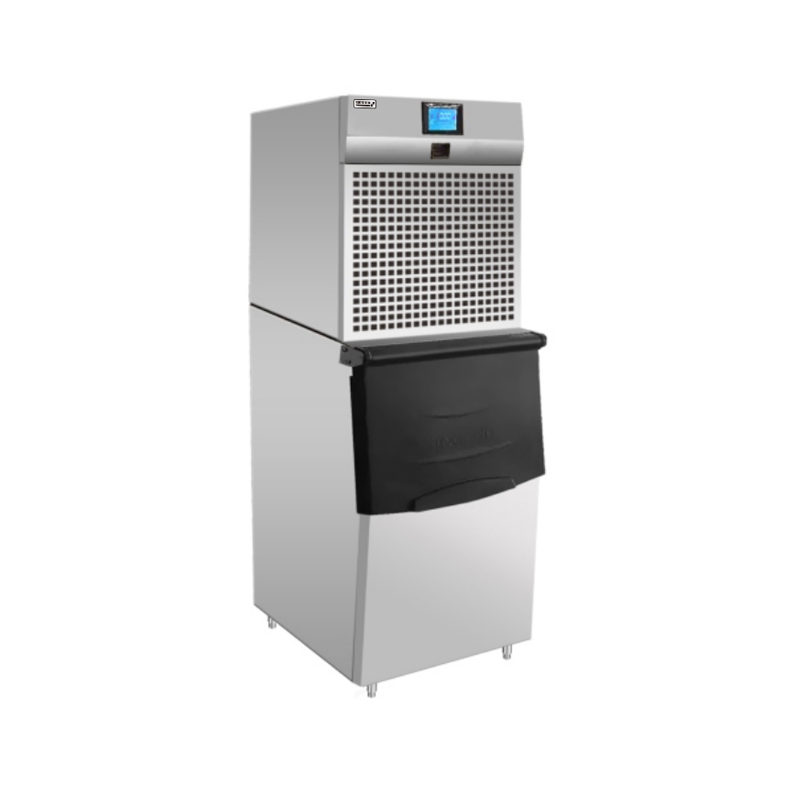
The word "countertop" gets used loosely in this trade. Broadly, three formats show up in small commercial settings. A true countertop machine sits on the bench and needs clearance above and behind it. An under-counter machine slides into a gap below the work surface and breathes through a front grille, so the joinery has to allow for that. A modular unit puts the ice-making head on top of a separate storage bin, which is handy when you want more storage than a compact cabinet can give you.
For most of the shops we work with, the decision comes down to countertop versus under-counter. A bench-top unit suits kiosks, pop-up bars, small dessert counters and places where the machine is expected to serve maybe 30 to 80 drinks a day. An under-counter model suits busier cafes and bars where the worktop itself is precious serving space and the ice point should sit within arm's reach of the shaker station.
Before you compare prices, measure three things: the usable height between bench and any wall cabinet, the depth available with the door fully open, and the distance to a drain. Those three numbers eliminate more models than any specification sheet will.
If you want a compact machine that fits neatly under a bar or prep counter and still produces a proper commercial cube, the
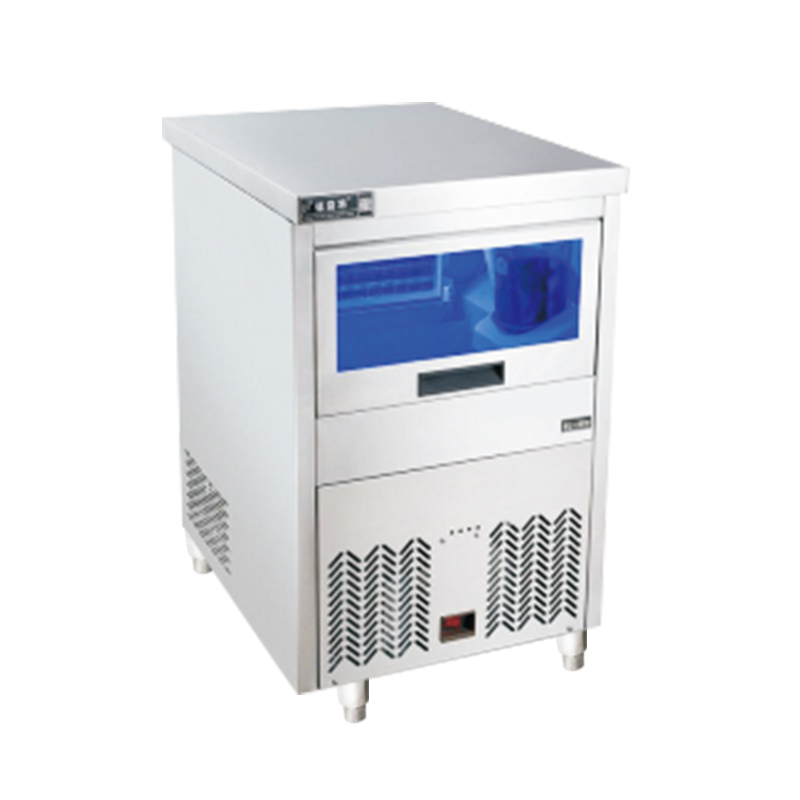 Blue Light Undercounter Commercial Ice MakerA compact commercial undercounter cube maker for bars and small drinks operations, with stainless steel construction, adjustable ice thickness, self-cleaning, and capacities from 36 to 454 kg/24h.View Product →
is the format we build most often for small and mid-sized drinks operations.
Ice is not a commodity. The shape of the cube changes how fast a drink dilutes, how it looks in the glass and how much space it takes up in the bin. Most countertop machines will produce one family of shapes, so choose with your menu in front of you rather than with a catalogue.
| Ice style | What it looks like | Where it works best |
|---|---|---|
| Standard square cube | Neat, dense block with flat faces | Soft drinks, iced coffee, takeaway cups |
| Crescent cube | Curved, softer profile | Cocktails, spirits and mixed drinks at the bar |
| Jumbo cube | Large, slow-melting block | Whisky, punch bowls, long sipping serves |
| Clear spray cube | Transparent, glassy appearance | Premium serves, cold brew, front-of-house display |
Milk-based drinks tolerate a slightly softer cube because the ice is doing cooling rather than dilution work. Spirit-forward menus usually want something denser that melts slowly. If your counter serves both, a standard square cube is the safest compromise, and it is the shape most customers expect when they order an iced latte.
We go deeper into thickness settings, harvest cycles and how each shape behaves in the glass in our guide to commercial cube ice maker specifications and ice types, which is worth a read before you settle on a model.
For shops that want a reliable everyday cube with straightforward servicing, the
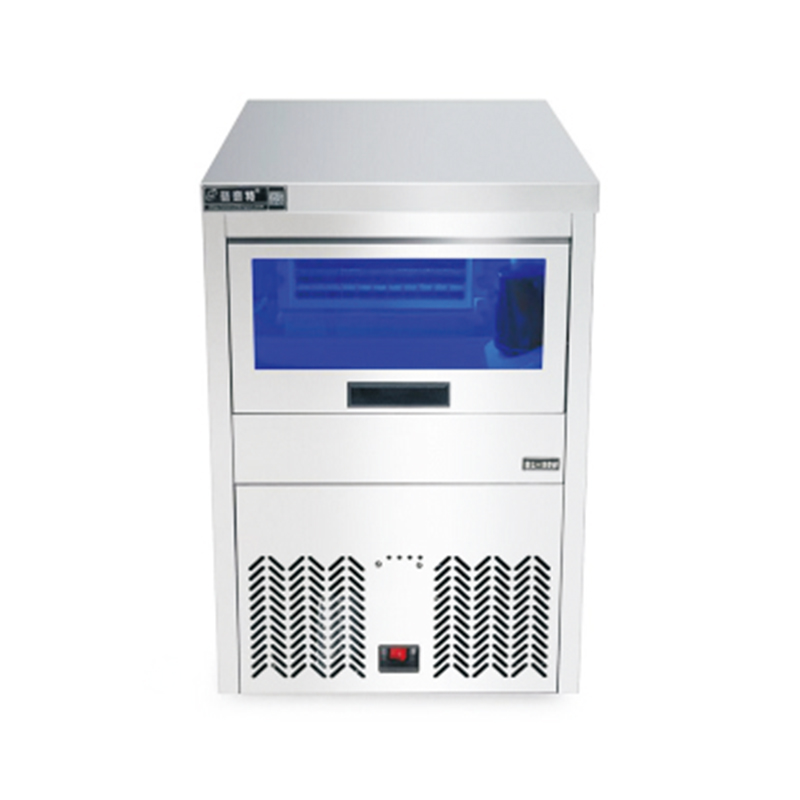 Square Cube Commercial Ice MachineAn everyday square-cube commercial ice maker with LCD controls, automatic cleaning, blue-light sterilization, adjustable thickness, and capacities from 36 to 2000 kg/24h for cafes and restaurants.View Product →
covers the bulk of cafe and restaurant demand.
Bars with a cocktail list often prefer a curved shape that sits well in a rocks glass and melts at a gentler rate — the
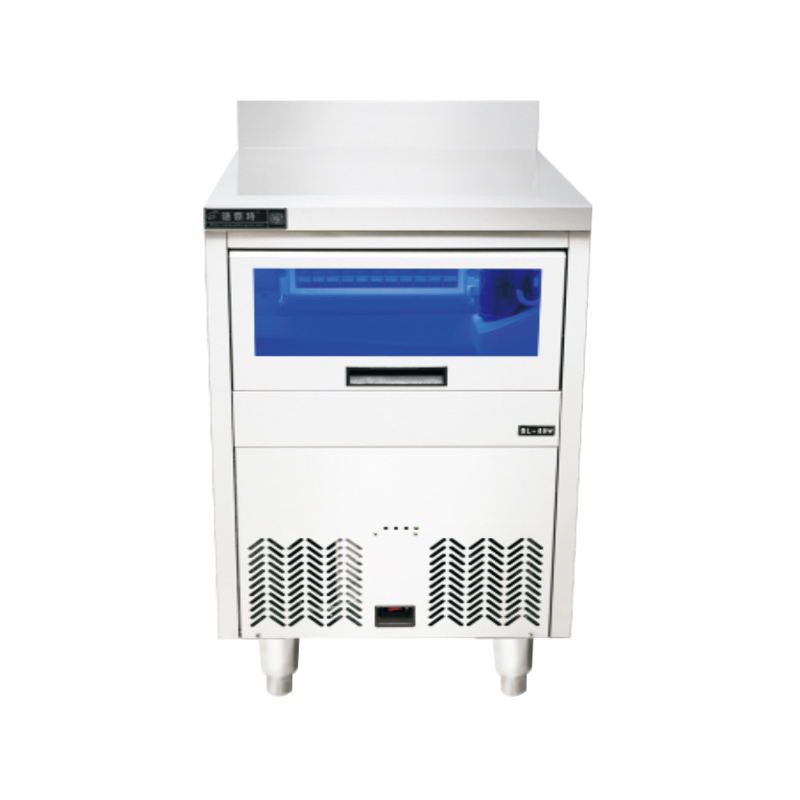 Crescent Shaped Commercial Ice MakerA commercial crescent-ice maker for cocktail bars, producing curved clear ice for rocks glasses, with computerized monitoring, stainless steel ice plate, and 45–1000 kg/24h capacity.View Product →
is the model we usually point them towards.
Published daily output figures are measured under test conditions, usually around 20 to 25°C ambient with cool inlet water. A machine rated at 40 kg per day in a lab will not deliver 40 kg on a 35°C afternoon in a kitchen with no extractor fan. Expect a meaningful drop in production as the room gets hotter, and size accordingly rather than buying the smallest unit that technically meets your average.
A simple piece of arithmetic helps more than any rule of thumb. A busy cafe serving 40 iced drinks an hour, each taking roughly 180 to 220 grams of ice, needs somewhere between 7 and 9 kg of ice per hour at peak. If that rush lasts three hours, you need 21 to 27 kg of ice available in the bin, or a machine that can keep producing while it empties.
Two practical rules we give customers: choose an output that produces at least one and a half times your estimated daily use over 24 hours, and choose a bin that holds at least half a day's demand. That buffer absorbs the gap between the morning fill and the lunchtime rush, and it means a single breakdown or a late delivery does not end service.
Air-cooled machines reject heat into the room, so where they sit matters. An under-counter unit needs a clear path for air at the front grille and a gap around the cabinet; boxing one into a tight joinery run with no louvre is the single most common installation mistake we see. Keep the machine away from ovens, fryers and direct sunlight, and never stack it directly against a wall at the rear unless the model is designed for it.
Water quality drives long-term reliability as much as any component. Hard water scales the evaporator, slows production and eventually shortens the machine's life. A simple inline filter and a habit of checking for scale will do more for uptime than an extended warranty. Where the room is genuinely hot and a mains water supply plus drain are both available, a water-cooled unit can hold performance better than an air-cooled one.
Drainage is the other quiet failure point. Gravity drains need a continuous fall to the outlet; where that is impossible, a drain pump is the answer, but it needs power and a little maintenance of its own. On the electrical side, check the rated current and confirm whether the machine needs a dedicated circuit — most compact commercial units do.
Our notes on sizing, venting and installing a built-in under-counter ice maker cover clearance distances and plumbing in more detail if you are working with a fitter or a joiner.
Ice is food, and health inspectors treat it that way. The good news is that a modest routine keeps almost any commercial machine in good shape.
Buying with maintenance in mind pays off here. Removable panels, accessible evaporators and stainless steel interiors turn a 45-minute job into a 15-minute one, which is the difference between a routine that survives a busy season and one that quietly stops happening.
A supplier who can answer all seven without checking a file is usually a supplier who will still be reachable in year three.
Shopping for a countertop ice cube maker is really a question of fit: fit under the bench, fit with the drinks you serve, and fit with the volume your busiest two hours demand. Get those three right and the machine becomes invisible, which is exactly what good equipment should be. We have been building stainless steel ice machines and bar equipment since 2006, and we are always happy to talk through a layout before you order anything.
You can browse the full range of commercial ice makers, from compact under-counter units to jumbo cube and snow ice models, and match one to the counter you actually have.

No.8 Xinhua Road, Dianshanhu Town, Kunshan City, Suzhou, Jiangsu Province, China
Call Us: +86-18217685733 / +86-18221531811
E-mail: [email protected] / [email protected]
Copyright © Jiangsu Bingluo Refrigeration Equipment Co., Ltd. All Rights Reserved. Commercial Refrigeration Equipment Solutions