 English
 русский
 Español
 عربى
عربىIndustry News
Home / News / Industry News / Back Bar Glass Door Merchandiser: A Practical Buying Guide for Bars and Cafés
2026-10-12
A back bar glass door merchandiser is one of those quiet pieces of equipment that decides how smoothly a shift runs. When bottles, cans and garnishes sit at eye level behind glass, bartenders and baristas grab what they need without stepping out of the well, and guests can see what is on offer from across the room. Choose well and the unit pays for itself in speed; choose badly and you spend the evening rearranging crates.
We have been building commercial refrigeration for bars, cafés, bakeries and hotels since 2006, and the same questions come up in every conversation: how much capacity, air-cooled or direct-cool, hinged or sliding doors? This guide walks through those decisions in plain language.
Content
The name describes the job. The back bar is the working zone behind the counter where drinks are stored, poured and served. A glass door merchandiser is a reach-in refrigerator with a transparent door, so the contents stay cold and stay visible. Put the two together and you have a slim, glass-fronted cooler that sits on or under the back bar, within arm's reach of whoever is serving.
That is what separates it from a plain storage fridge: the door is part of the sales floor. Bottled beer, soft drinks, juices, premixed cocktails and even garnishes look better behind glass, and interior lighting turns a cooler into a display. Closed doors also hold temperature more steadily than an open case, which matters in a warm, humid room where the door opens dozens of times an hour. If you are weighing both formats, it is worth reading how open and closed display cases compare in efficiency and usability before you commit.
Every venue has its own rhythm, but the reasons operators keep coming back to glass door units are consistent:
Behind the glass, two cooling approaches dominate commercial cabinets, and each behaves differently in a busy bar.
| Consideration | Air-cooled | Direct-cool |
|---|---|---|
| How it works | A fan circulates cold air around the cabinet | Evaporator plates cool the walls directly |
| Temperature recovery | Fast after door openings | Slower, but very stable at rest |
| Evenness | Very even, shelf to shelf | Slight variation between shelves |
| Noise | Audible fan hum | Whisper quiet |
| Defrost | Automatic | Manual defrosting required |
| Best suited to | Bottles, cans and high-traffic bars | Quiet rooms, packaged goods and backup stock |
For most back bars, air cooling is the practical choice: fans push cold air into every corner, recovery after a door opening is quick, and automatic defrost keeps the cabinet working without staff intervention. Insulation quality matters just as much as the system itself, so look for a thick, foam-injected body and stainless steel where the cabinet meets spills, steam and cleaning chemicals. A unit that rusts at the base will not last the decade a bar expects from it. Our own 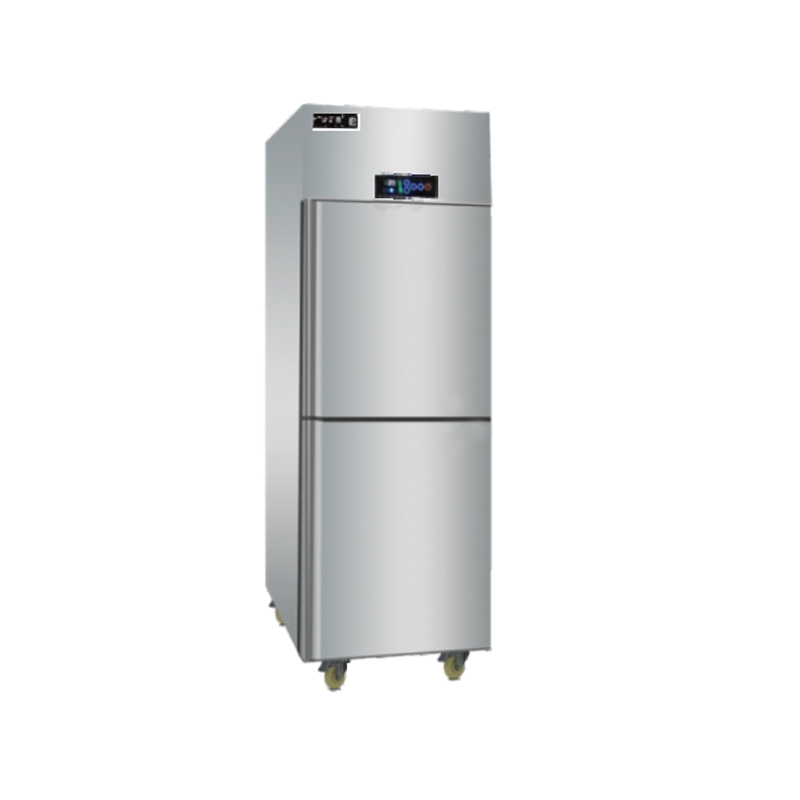 Commercial Upright Air-Cooled Stainless Steel Refrigerator SeriesFor back-bar cooling, this upright series combines air-cooled operation, thickened insulation, stainless steel construction, digital temperature control, and refrigeration or freezing modes.View Product → was designed around exactly that duty cycle.
Once the basics are settled, small details decide how pleasant a merchandiser is to live with for the next several years.
Capacity is usually estimated backwards from the menu. Count how many bottled or canned products you sell on a busy night, then add roughly 30 percent as buffer stock. Depth matters as much as width, because a cabinet that blocks the aisle when its door swings open will annoy your team for years.
A merchandiser rarely travels alone. It shares the counter with an ice bin, a glass washer, a speed rail and often a coffee or milk steaming station. Fixing the sequence of those stations early saves a great deal of frustration later: the cooler should sit where staff naturally turn, close to the point of pour but away from ovens, fryers and direct sunlight. Height deserves a second look too, since a unit that blocks the sightline between bartender and guest is a problem no specification sheet will mention.
When the layout is unusual, a standard cabinet can be the wrong answer. That is why we also offer 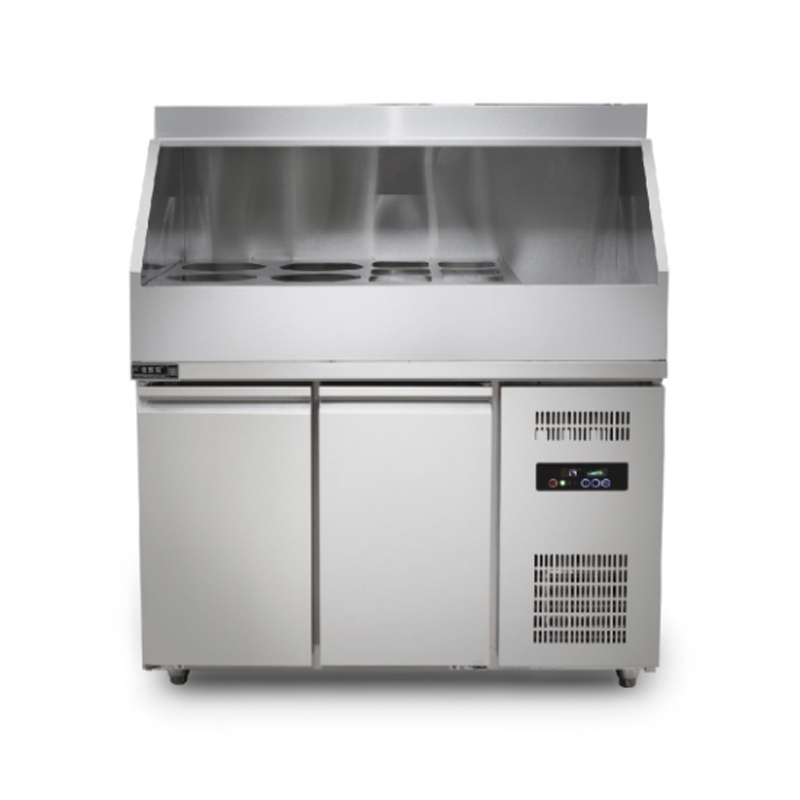 Custom Commercial Bar Counters and Back BarsExplore custom back bars with integrated refrigeration, bar counters, water bars, cashier counters, and Series 500 units, with layout, material, and finish options.View Product →, built around your floor plan rather than a catalogue number.
Most glass door merchandisers need surprisingly little attention, but the small habits matter. Leave a few centimetres of clearance around the vents so the condenser can breathe, keep the unit out of the hottest corner of the room, and level the cabinet on its castors or feet so the doors close under their own weight.
Handled this way, a well-built cabinet will hold its temperature for years, which is the only performance measure that really counts.
Refrigeration is a long-term purchase, and the specification sheet is only half the story. Ask how the cabinet is built, what the warranty covers, and whether spare gaskets, hinges and shelves will still be available in three years. We manufacture in a 12,500 square metre facility in Jiangsu and have been supplying bars, cafés, hotels, bakeries and supermarkets since 2006, so the conversation usually comes back to the same practical questions: what will you store, how often will the door open, and what does the room feel like in July. You can browse our commercial refrigerators or send a layout sketch and let us suggest a size.
A back bar glass door merchandiser is a small investment next to the rest of a fit-out, yet it shapes how quickly drinks leave the bar and how good the display looks while they wait. Decide capacity from your menu, choose air cooling for busy service, insist on stainless steel and serviceable gaskets, and plan the position before you order. Do those four things and the cabinet will quietly disappear into the background, which is exactly where it belongs.

No.8 Xinhua Road, Dianshanhu Town, Kunshan City, Suzhou, Jiangsu Province, China
Call Us: +86-18217685733 / +86-18221531811
E-mail: [email protected] / [email protected]
Copyright © Jiangsu Bingluo Refrigeration Equipment Co., Ltd. All Rights Reserved. Commercial Refrigeration Equipment Solutions