
 English
 русский
 Español
 عربى
عربىIndustry News
2025-12-05
Industry News
The Unsung Hero of Chill: How Your Ice Maker Works
From a frosty cocktail on a summer evening to a cooler packed for a picnic, ice is a modern necessity we often take for granted. Before the widespread use of freezers and automated ice makers, getting a steady supply of ice was a laborious process involving ice houses and massive logistical efforts. Today, the humble ice maker, whether a standalone appliance or a feature inside your refrigerator, performs this small miracle with efficient, fascinating science.
Content
The Science of Freezing: From Water to Ice
At its core, an ice maker is simply a machine that exploits the physical property of water: it turns into a solid—ice—when its temperature drops below its freezing point.
The Phase Change
Water is made of $H_2O$ molecules. In its liquid state, these molecules are constantly moving, slipping past one another. To turn liquid water into solid ice, we must remove enough thermal energy (heat) to slow these molecules down. Once they slow sufficiently, the attractive forces between the molecules lock them into a rigid, repeating pattern called a crystal lattice. This transformation is known as a phase change.
The Refrigeration Cycle
The heat removal process is the job of the refrigeration system, which is identical in principle to what cools your entire refrigerator or air conditioner. This cycle involves four key components and a special fluid called a refrigerant.
- Compressor: This is the heart of the system. It pressurizes the gaseous refrigerant, which dramatically raises its temperature.
- Condenser Coils: The hot, high-pressure refrigerant flows through coils, usually on the back or bottom of the appliance. It releases its heat into the surrounding air (the kitchen). As it cools, the refrigerant turns back into a liquid.
- Expansion Valve (or Capillary Tube): The liquid refrigerant passes through a narrow valve, which rapidly reduces its pressure. This sudden drop in pressure causes the refrigerant to instantly become much colder.
- Evaporator Coils: This is where the magic happens for the ice maker. The super-cold liquid refrigerant flows through coils, which are usually in direct contact with the ice-forming tray. This cold surface rapidly draws heat out of the water, causing the water to freeze. The refrigerant, having absorbed the heat, turns back into a gas and flows back to the compressor to start the cycle again.
Anatomy of an Automatic Ice Maker
In most modern refrigerators, the automatic ice maker works on a simple, timed cycle, usually producing a batch of ice every one to two hours.
The Water Supply
First, the ice maker needs water. A solenoid valve controls the flow of water from your home’s main line (usually filtered) into a small, plastic or metal ice mold or tray. This valve is typically triggered by a timer or a sensor.
Freezing and Sensing
Once the mold is filled, the evaporator coils surrounding the mold begin to chill the water. The timing of this step is crucial. Once the water is completely frozen, one of two common methods signals that the ice is ready:
- Thermostat/Timer: A basic system uses a simple timer. After a predetermined amount of time (e.g., 60 minutes), the machine assumes the ice is solid.
- Optical Sensor (Infrared Beam): More sophisticated systems use an infrared beam shone across the ice storage bin. When the beam is blocked by a pile of ice, the machine stops production. When the level drops, the beam is unblocked, and production resumes. This is often referred to as a full sensor.
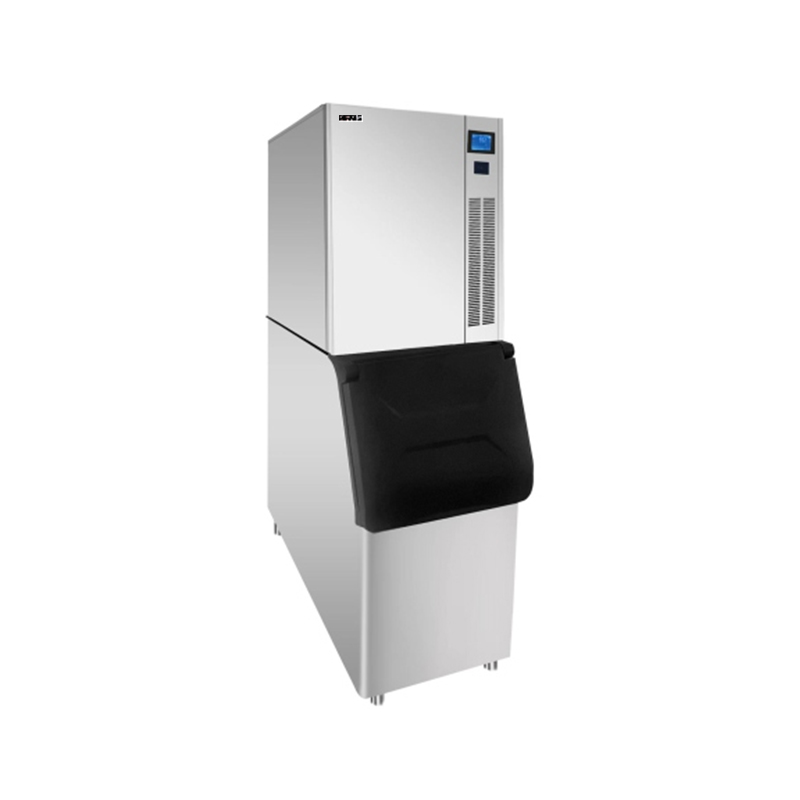
Harvesting the Ice
Once the ice is fully formed, it must be released from the mold—the process known as harvesting.
- Heating Element: A small heating element near the mold is briefly activated (for about 10-15 seconds). This slightly warms the mold’s surface, just enough to melt a tiny layer of ice and release the cubes, but not enough to melt the cubes themselves.
- Ejector Arm: A motorized ejector arm or rake then sweeps across the mold, pushing the loosened cubes out and into the storage bin below. The loud clunk you hear is the sound of the cubes dropping into the bin.
The Shut-Off Mechanism
For convenience, automatic ice makers need to stop making ice when the bin is full. This is achieved by a wire shut-off arm (or bail wire). This arm rests on top of the ice pile. As the ice bin fills up, the cubes push the arm up and hold it in the ‘up’ position. This physical movement trips a switch, which tells the ice maker to halt its cycle. Once ice is used and the pile drops, the arm falls back down, triggering the machine to start making ice again.
The continuous, quiet cycle of freezing, heating, and ejecting is a testament to clever engineering, providing us with a continuous, on-demand supply of perfectly frozen water.
Beyond the Fridge: Specialty Ice Makers
While the refrigerator ice maker is the most common, specialized units use different techniques to create specific types of ice for commercial and home use.
Flake and Nugget Ice
- Flake Ice: Used primarily in grocery store displays for seafood, flake ice is produced by scraping a layer of ice off a chilled vertical drum.
- Nugget Ice (or Chewable Ice): A popular choice in restaurants and hospitals, this soft, porous ice is made by compressing flake ice into small, airy pellets.
Clear Ice Makers
A common complaint with refrigerator ice is its cloudy appearance, caused by trapped air bubbles and minerals freezing into the center of the cube. Clear ice makers (often used by bartenders or for high-end drinks) solve this by mimicking the process of natural lake freezing: they freeze water slowly and directionally.
By freezing the water from the bottom or top layer first and keeping the water constantly agitated, air bubbles and impurities are pushed out and concentrated into the last bit of water to freeze, which is usually discarded. The result is crystal-clear, dense ice that melts slower and doesn’t dilute drinks as quickly.
Related Products


No.8 Xinhua Road, Dianshanhu Town, Kunshan City, Suzhou, Jiangsu Province, China
Call Us: +86-18217685733 / +86-18221531811
E-mail: [email protected] / [email protected]
Copyright © Jiangsu Bingluo Refrigeration Equipment Co., Ltd. All Rights Reserved. Commercial Refrigeration Equipment Solutions
